





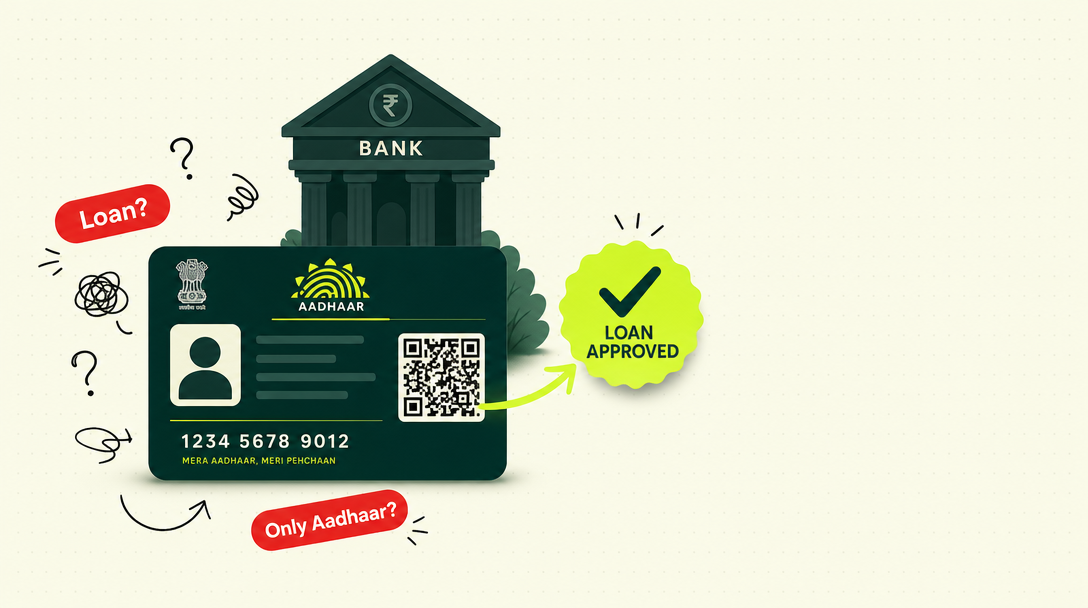
Get a loan on your Aadhaar card in 5 minutes” is one of the most searched lending phrases in India, with about 10,000 searches a month for “Aadhaar card loan” alone. The promise is attractive: no salary slips, no bank visits, just a 12-digit number.
The reality is narrower. Aadhaar makes the identity and paperwork part of a loan fast. It does not decide whether you get approved, how much you get, or what rate you pay. This guide separates what Aadhaar actually does in lending from what the ads suggest, and shows what you need for a loan that is both fast and fairly priced.
What an “Aadhaar card loan” really is
There is no separate loan product called an Aadhaar card loan. The phrase describes a digital personal loan where Aadhaar is used for KYC, so the borrower does not need to submit physical copies of identity and address proof.
The loan itself is an ordinary unsecured personal loan from a bank or NBFC, priced on your income, credit history, and existing debts. Aadhaar is the paperwork shortcut, not the credit decision.
What Aadhaar does in the loan process
Aadhaar plays three roles in a digital loan:
- e-KYC. An OTP sent to your Aadhaar-linked mobile lets the lender pull your name, photo, date of birth,h and address from UIDAI. This replaces physical ID and address proof.
- eSign. Aadhaar-based eSign lets you sign the loan agreement digitally.
- eNACH mandate. Many lenders use Aadhaar or net-banking authentication to set up auto-debit for EMIs.
With all three, a loan can move from application to disbursal without paper. That is the genuine benefit, and it is why disbursal within 24 hours is now common for salaried borrowers with clean profiles.
What lenders still check
Every regulated lender still runs the same underwriting checks, whatever the ad says:
| Check | What the lender looks at | Why it matters |
|---|---|---|
| PAN | Identity and credit bureau lookup | Your credit report is pulled using PAN; almost every lender requires it |
| Credit score and report | CIBIL or other bureau score, repayment history, enquiries | Decides approval and rate; most lenders prefer 700+ for unsecured loans |
| Income | Salary credits in bank statements, salary slips, or ITR for self-employed | Decides the loan amount |
| Existing EMIs | FOIR (fixed obligations to income ratio) | Lenders usually cap total EMIs at 40%–55% of income |
| Employment | Employer category, job stability, business vintage | Affects rate and eligibility |
So an “Aadhaar card loan” still needs PAN, a credit history,ry and verifiable income. The difference is only that you do not upload identity documents by hand.
Our explainer on FOIR and personal loans shows how lenders calculate the amount you can borrow.
The ₹60,000 limit most people have not heard of
RBI’s Know Your Customer Master Direction treats OTP-based Aadhaar e-KYC, done without face-to-face or video verification, as a limited form of KYC. Accounts opened this way carry restrictions, including a ceiling on term loans of ₹60,000 in a year.
This is why many app-based “instant Aadhaar loans” are small: ₹5,000 to ₹50,000. For a larger loan, the lender has to complete full KYC. In digital journeys, this usually means:
- Video KYC (V-CIP): a short live video call with the lender’s official, or
- Biometric or offline Aadhaar XML verification, or
- DigiLocker-based document fetch combined with other checks.
If you are looking for ₹2 lakh or more, expect one of these steps. It usually takes minutes, not days.
Typical loan amounts and rates
The amount and price depend on your profile, not on Aadhaar. Indicative ranges for 2026:
| Borrower profile | Typical amount | Typical rate (per annum) |
|---|---|---|
| Salaried, 750+ score, reputed employer | ₹2 lakh–₹25 lakh | 10.5%–16% |
| Salaried, 650–750 score | ₹50,000–₹5 lakh | 16%–24% |
| Self-employed with ITR and bank statements | ₹1 lakh–₹15 lakh | 14%–24% |
| Thin file or new to credit, small-ticket apps | ₹5,000–₹50,000 | 24%–36% or more, plus fees |
Figures are indicative and vary by lender. The last row is where most “Aadhaar-only” ads sit. The effective cost there is often much higher than the headline rate once processing fees and short tenures are counted.
Documents you will actually need
For a fully digital personal loan in 2026, keep these ready:
Salaried
- Aadhaar (for e-KYC and eSign) and PAN
- Last three months’ salary slips, or a salary account statement via Account Aggregator
- Six months’ bank statements if salary is credited elsewhere
Self-employed
- Aadhaar and PAN
- Last two years’ ITR with computation of income
- 12 months’ bank statements
- Business proof such as GST registration or Udyam certificate
The full list, by profile, is in our personal loan documents checklist.
Red flags: when an Aadhaar loan offer is a trap
The “loan on Aadhaar only” pitch is also the most common hook used by illegal lending apps. Watch for these signs:
- The app is not linked to a named RBI-registered bank or NBFC, or the lender’s name is not on its website.
- It asks for access to your contacts, photo gallery, or call logs. RBI’s digital lending rules do not permit lenders to access these.
- There is no Key Fact Statement showing APR, fees, and total repayment before you accept.
- It asks for an upfront “processing” or “insurance” fee before disbursal.
- Tenure is 7 to 15 days, with repayment far above the amount received.
- The money arrives from, or goes to, a personal account or UPI ID instead of the lender’s account.
If any of these appear, stop. Our guide on how to identify a fake loan app covers the checks in detail, and RBI now lists digital lending apps reported by regulated entities, so you can verify an app before you share your Aadhaar OTP.
Never share an Aadhaar OTP with a caller. A genuine lender will only ask you to enter it on its own app or website.
When a regular personal loan is the better route
If you are salaried with a credit score above about 700, a small Aadhaar-only app loan is almost always the more expensive option. A regular personal loan uses the same Aadhaar e-KYC, disburses just as fast, and costs far less.
Consider the cost difference on ₹1 lakh borrowed:
- Small-ticket app: 30% a year for 6 months plus a 5% processing fee costs roughly ₹13,900 in interest and fees, with an EMI of about ₹18,150.
- Personal loan from a bank or large NBFC: 13% a year over 12 months plus a 2% fee costs roughly ₹9,200, with an EMI of about ₹8,930.
The gap widens quickly as amounts grow.
Use cases
Salaried, needs ₹3 lakh for a family expense. Aadhaar e-KYC plus salary account data via Account Aggregator gets approval in hours. Video KYC completes full KYC for the larger amount. Disbursal happens the same day or the next day.
Freelancer with irregular income. Aadhaar handles KYC, but approval depends on ITR and 12 months of bank credits. A lender that underwrites self-employed profiles is the right match; an “Aadhaar-only” app is not.
Key takeaways
- An Aadhaar card loan is a digital personal loan that uses Aadhaar for KYC and eSign.
- Approval, amount, nd rate still depend on PAN, credit score, income, and existing EMIs.
- OTP-only Aadhaar KYC limits term loans to ₹60,000 a year; larger loans need video or biometric KYC.
- Offers promising loans on Aadhaar alone, with contact access or upfront fees, are red flags.
- For salaried borrowers with fair credit, a regular personal loan is just as fast and far cheaper.
Frequently Asked Questions
Not from a regulated lender. Aadhaar completes KYC, but lenders also need PAN for a credit check and proof of income to decide the amount.
Yes. Every regulated lender checks your credit report using your PAN before approving a loan.
Often yes, if your salary is credited to a bank account the lender can verify, or if you are self-employed with ITR and bank statements.
It is safe when the lender is an RBI-regulated bank or NBFC, or a platform that names its lending partners, shows a Key Fact Statement, and does not ask for upfront fees or contact access.
It depends on income and credit score, not on Aadhaar. With OTP-only e-KYC, term loans are capped at ₹60,000 a year. Salaried borrowers who complete full KYC commonly get ₹2 lakh to ₹25 lakh.
Conclusion
Aadhaar has made borrowing faster in India. It has not made it free of underwriting, and the lenders who pretend otherwise are usually the ones to avoid.
The better question is not “can I get a loan on Aadhaar?” but “which lender will approve my profile at the lowest cost?” TapTap Loans assesses your profile with a soft check that does not affect your credit score and matches you with the most suitable of 20+ banks and NBFCs, fully digitally.