





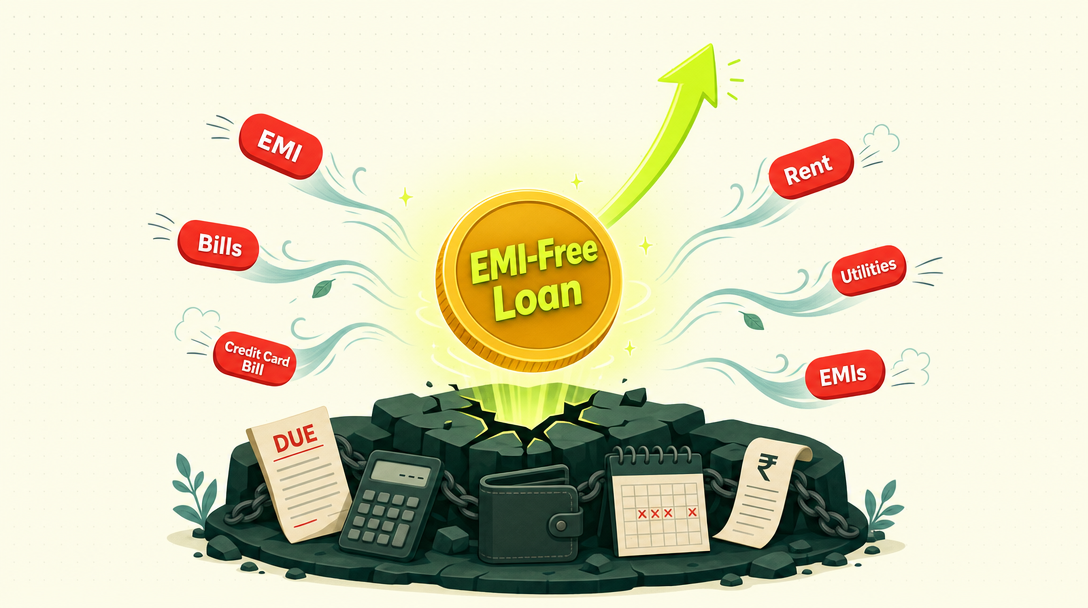
An EMI-free personal loan doesn’t mean the loan is free. It means your repayment structure is different, often interest-only for a period, with the principal due later, or structured as a bullet repayment. This guide explains exactly how it works and what to watch for.
The Simple Idea
A standard personal loan has you pay a fixed EMI every month, covering both principal and interest, from day one. An EMI-free structure changes this. Some versions have you pay only interest for a period, with the full principal due at the end. Others pause payments entirely for a set window, before standard EMIs begin.
Why This Structure Exists
Some borrowers have irregular income, or expect a large sum, a bonus, or a matured investment, at a specific future point. An EMI-free structure can align repayment with that expected timing, rather than forcing fixed monthly payments that don’t match actual cash flow.
Common Types of EMI-Free Structures
Interest-only period, then standard EMI. You pay just interest for a set period, then switch to full EMI payments covering both principal and interest.
Bullet repayment. You pay little to nothing during the tenure, with the full principal, plus accrued interest, due as a lump sum at the end.
Step-up EMI. Payments start low and increase over time, rather than staying fixed; useful if you expect rising income.
Is It Actually Interest-Free?
No, seldom. “EMI-free” refers to the repayment structure, not the cost. Interest still accrues throughout, and in bullet repayment structures particularly, the total interest can be substantial once it all comes due at the end.
A Worked Example
Borrow ₹3,00,000 through a bullet repayment structure, at 14%, over 2 years, with no payments until the end. At maturity, you owe not just the ₹3,00,000 principal, but the full accumulated interest too, potentially over ₹90,000, all due at once, rather than spread across 24 manageable payments.
A Quick Comparison Table
| Structure | Monthly Payment | Total Cost | Risk |
|---|---|---|---|
| Standard EMI | Fixed, every month | Predictable | Low, steady obligation |
| Interest-only period | Interest only, then full EMI | Similar or slightly higher | Payment jumps after the interest-only period |
| Bullet repayment | Minimal or none | Can be highest, interest compounds | Large lump sum due at the end |
Who This Structure Genuinely Suits
Borrowers with a specific, reliable, future source of funds, a maturing investment, an expected bonus, a property sale, timed to match the loan’s structure. It’s a narrower use case than it might initially appear.
The Real Risk of This Structure
If your expected future funds don’t materialize as planned, you’re left facing a large, lump-sum obligation you may not be able to meet. This is a genuinely serious risk, worth weighing carefully against the appeal of lower payments now.
Questions to Ask Before Choosing This Structure
What exactly happens to the principal during any interest-only period; does it grow, or stay the same? What is the total cost, calculated in full, not just the lower initial payment? What happens if I can’t make the final lump-sum payment as planned? How to Evaluate If This Fits Your Situation
Be honest about how certain your expected future funds genuinely are. A confirmed, contractually guaranteed payout is different from an optimistic expectation. Only consider this structure if your future funding is close to certain, not just hoped for.
A Safer Alternative for Similar Needs
If you’re drawn to this structure mainly for lower payments now, consider instead a longer-tenure standard EMI loan, which lowers your monthly payment predictably, without the concentrated risk of a large lump sum due later.
What Lenders Look For Before Offering This Structure
Lenders offering EMI-free structures typically want strong evidence of your future repayment capacity, not just your current income. This might include documentation of an expected bonus, investment maturity dates, or other verifiable future cash flow.
Frequently Asked Questions
No. Interest continues accruing throughout the tenure, even though your regular payment structure looks different from a standard EMI.
This creates serious financial difficulty, similar to defaulting on a large debt, with real consequences for your credit score and potential legal recovery.
Borrowers with a confirmed, reliable future source of funds that aligns with the loan’s structure, not those simply seeking lower payments without a clear repayment plan.
Yes, for most borrowers. The predictable, steady obligation is easier to plan around than a structure that concentrates risk into a future lump-sum payment.
Check the interest rate, total repayment amount, final lump-sum payment, fees, and the exact repayment date. Make sure you have a reliable source of funds to meet the final payment.
Conclusion
An EMI-free loan can offer short-term payment flexibility, but it does not eliminate the cost of borrowing or the repayment obligation. The large final payment can create significant financial pressure if your expected funds do not arrive on time. For most borrowers, a standard EMI structure is easier to budget for and carries less repayment risk.
Considering your loan structure options? Compare standard and flexible loan offers with TapTap across 20+ lenders.