





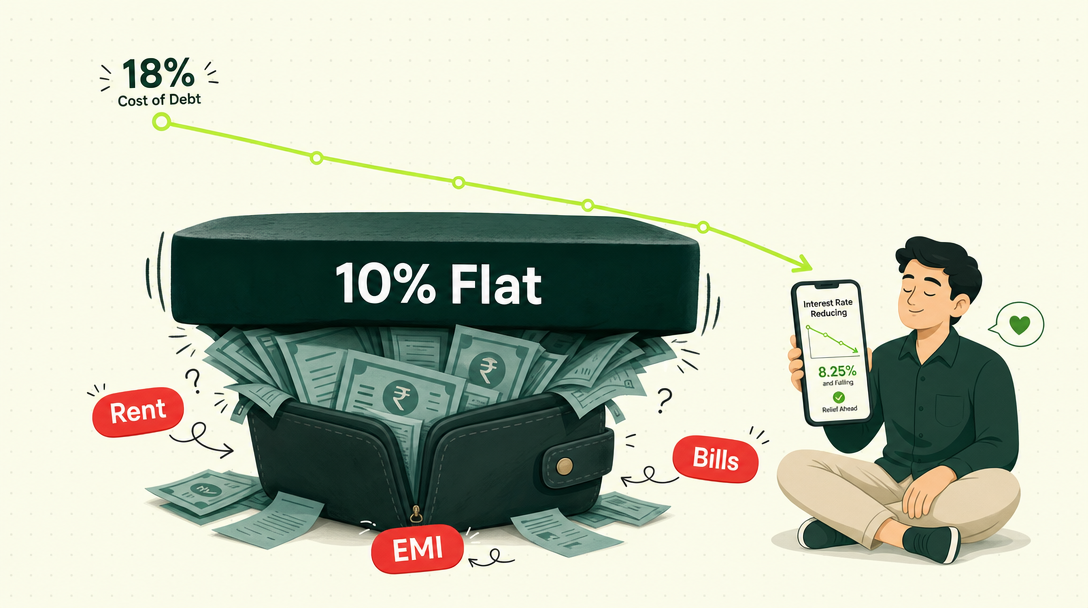
Two lenders offer you ₹5 lakh for 3 years. One quotes 10%. The other quotes 16%. The first looks like the obvious choice, until you notice the 10% is a “flat” rate,e and the EMI is higher than the 16% offer.
This is not a trick of arithmetic. Flat and reducing rates measure interest on different amounts, so the same number means very different costs. Knowing how to convert one into the other is one of the most useful skills a borrower can have, and it takes about two minutes to learn.
What a reducing balance rate is
Under the reducing balance method, interest each month is charged only on the principal still outstanding. As you pay EMIs, the principal shrinks, and so does the interest portion of each EMI.
The EMI stays constant, but its make-up changes: early EMIs are mostly interest, later EMIs are mostly principal. Almost all bank and large NBFC personal loans in India use this method.
The EMI formula is:
EMI = P × r × (1 + r)^n / [(1 + r)^n − 1]
where P is the principal, r is the monthly rate (annual rate ÷ 12 ÷ 100), and n is the number of months. Our guide to how EMI is calculated walks through it step by step.
What a flat interest rate is
Under the flat method, interest is calculated on the full original principal for the entire tenure, even though you repay part of it every month.
The calculation is simple:
- Total interest = Principal × flat rate × years
- EMI = (Principal + Total interest) ÷ number of months
Because interest never falls as you repay, you pay interest on money you have already returned. That is why a flat rate always costs more than the same number quoted as reducing.
The same loan, two methods
Take ₹5 lakh for 3 years.
| 10% flat | 10% reducing | 12% reducing | |
|---|---|---|---|
| EMI | ₹18,056 | ₹16,134 | ₹16,607 |
| Total interest | ₹1,50,000 | ₹80,800 | ₹97,858 |
| Effective reducing rate | about 17.9% | 10% | 12% |
The 10% flat loan costs about ₹69,000 more than a 10% reducing loan, and about ₹52,000 more than a 12% reducing loan. Its true cost is equivalent to a reducing rate of roughly 17.9%.
Flat to reducing: conversion table
The effective reducing rate for a flat rate depends on tenure. The table below shows equivalents for a loan repaid in equal monthly instalments.
| Flat rate | 1 year | 3 years | 5 years |
|---|---|---|---|
| 8% | 14.5% | 14.6% | 14.1% |
| 9% | 16.2% | 16.2% | 15.7% |
| 10% | 18.0% | 17.9% | 17.3% |
| 12% | 21.5% | 21.2% | 20.3% |
| 14% | 24.9% | 24.4% | 23.3% |
A quick rule of thumb: multiply the flat rate by about 1.7 to 1.8 for a rough reducing equivalent. For an exact figure, compute the EMI under the flat method and find the reducing rate that produces the same EMI, which any EMI calculator can do by trial.
Where you still see flat rates in India
Most personal loans from banks and larger NBFCs are quoted on a reducing basis. Flat rates still appear in:
- Consumer durable and point-of-sale financing
- Some used-vehicle and two-wheeler loans
- Smaller NBFCs and informal or semi-formal lenders
- Some loan app offers expressed as “only 2% per month”
- Offers from agents who quote “per lakh per month” figures
The “per month” framing is common in lending apps. “2% per month flat” is 24% a year flat, which is roughly 40% or more on a reducing basis over a short tenure, before fees.
How APR and the KFS help you compare
RBI now requires regulated lenders to give retail borrowers a Key Fact Statement (KFS) before the loan is signed. The KFS must show the Annual Percentage Rate (APR), which is the all-in annual cost including interest and most fees, calculated on a reducing basis.
This matters because it removes the flat-versus-reducing problem at the source. If two lenders quote differently, compare the APR in their KFS documents. The APR will also expose high processing fees that a low headline rate can hide.
Our guide to the Key Fact Statement and APR explains each line of the document.
How to compare any two offers
- Ask which method is used. If the quote does not say “reducing” or “diminishing”, ask directly.
- Compare EMIs for the same amount and tenure. The loan with the lower EMI for identical terms is cheaper in interest.
- Add fees. Add processing fee, insurance, and any mandatory charges to the total cost.
- Check the APR. Ask for the KFS before accepting. It is your right under RBI rules.
- Check prepayment terms. A cheaper loan with heavy foreclosure charges may cost more if you plan to prepay.
Use cases
Two-wheeler dealer offer. A dealer quotes 7.5% flat for 2 years on ₹80,000. The effective reducing rate is roughly 13.5% to 14%. A personal loan at 12% reducing, if available, would be cheaper.
Loan app “1.5% per month”. That is 18% flat a year, which over a 6-month tenure equals roughly 30% on a reducing basis, before the processing fee.
Key takeaways
- Flat rates charge interest on the original principal for the full tenure; reducing rates charge only on what is still owed.
- A 10% flat rate is roughly 17% to 18% reducing.
- “Per month” quotes are usually flat and often far costlier than they sound.
- The APR in your KFS is the fairest single number for comparing offers.
- Compare EMI and total cost for identical amounts and tenures before deciding.
Frequently Asked Questions
For the borrower, a reducing rate is better at the same headline number, because interest falls as you repay. A flat rate is only competitive if its number is roughly half the reducing rate on offer.
Calculate the flat EMI, then find the reducing rate that gives the same EMI for the same tenure. As a rough guide, multiply the flat rate by about 1.7 to 1.8.
Most banks and large NBFCs use the reducing balance method for personal loans. Flat rates are more common in consumer durables s, some vehicle loans, and small-ticket app loans.
No. APR includes the interest rate and most fees, expressed as an annual rate on a reducing basis. It is usually higher than the headline rate.
Often less than you expect. Some flat-rate lenders calculate foreclosure on the remaining flat interest schedule. Read the foreclosure clause before prepaying.
Conclusion
A loan’s headline rate is only meaningful once you know how it is calculated. Converted to a common basis, a “cheap” flat rate often turns out to be the most expensive offer on the table.
TapTap Loans shows offers from 20+ banks and NBFCs on a like-for-like reducing basis, with the APR and fees visible before you choose.