





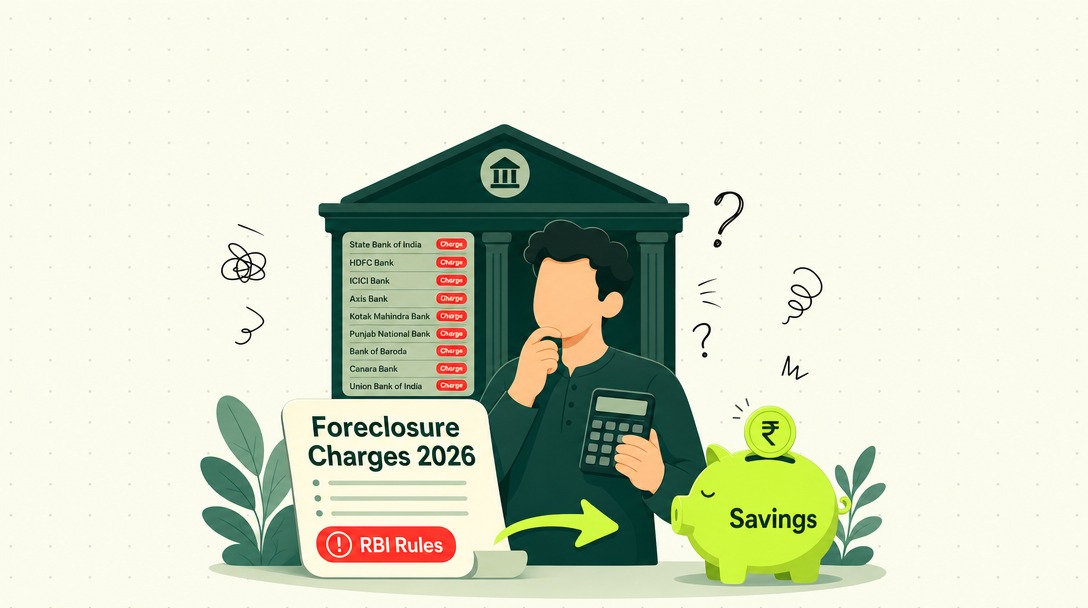
You’ve come into some money: a bonus, an FD maturity, a property sale. You want to close your personal loan early and stop paying interest. Smart instinct. But before you write the cheque, you need to answer two questions: how much will the lender charge for foreclosing, and will closing the loan early actually save you money after those charges?
Foreclosure charges in India range from 0% (if your loan is an RBI-protected floating rate) to 5% (for some NBFC fixed-rate products). For a ₹5L outstanding, that’s a difference of ₹25,000 in upfront cost. This guide gives you the current bank-wise list, the RBI rules that determine when foreclosure is free, and the math of when foreclosure actually pays off versus partial prepayment versus balance transfer.
Foreclosure vs Prepayment vs Part-Payment
Three different terms, often confused:
| Term | Meaning |
|---|---|
| Foreclosure | You pay off the ENTIRE outstanding principal in one go, closing the loan completely. |
| Prepayment | Often used interchangeably with foreclosure, but technically can mean any payment beyond your regular EMI. |
| Part-Payment | You pay a lump sum BEYOND the regular EMI, reducing the outstanding principal. The loan continues with reduced principal. |
Each has different rules and charges. This blog focuses on foreclosure but covers the comparison where useful.
RBI’s Stance: Floating vs Fixed Rate
RBI has progressively restricted foreclosure charges. The current position (2026):
- Floating-rate retail loans (home loans, LAP, education loans): Zero foreclosure charges for individual borrowers under RBI directive.
- Fixed-rate retail loans (most personal loans): Banks/NBFCs can charge foreclosure penalties as per their policy, usually 2–5%.
- Business-purpose loans: Foreclosure rules vary; not subject to the same individual-borrower protection.
Most personal loans in India are fixed-rate. That’s why they typically carry 2–4% foreclosure charges. Check your sanction letter to confirm whether your loan is fixed or floating.
Bank-Wise Foreclosure Charge Table (2026)
| Lender | Foreclosure Charge | Lock-In Before Foreclosure | Rate Type |
|---|---|---|---|
| SBI | Nil (after 6 EMIs) | 6 months | Floating in some products |
| HDFC Bank | 2–4% on outstanding | 12 months | Fixed mostly |
| ICICI Bank | 3–5% on outstanding | 12 months | Fixed |
| Axis Bank | Nil after 36 EMIs; 2–3% before | 12 months | Fixed |
| Kotak Mahindra | 3–4% | 12 months | Fixed |
| IDFC First | Nil after 13 EMIs | 13 months | Floating linked |
| IndusInd Bank | 3–4% | 12 months | Fixed |
| Bajaj Finance | 4% on outstanding | 12 months | Fixed |
| Tata Capital | 3–4% on outstanding | 12 months | Fixed |
| Aditya Birla Capital | 4–5% | 12 months | Fixed |
| Poonawalla Fincorp | 4% on outstanding | 12 months | Fixed |
| L&T Finance | 3–4% | 12 months | Fixed |
Always confirm with your specific lender; charges can change and are negotiable. Some lenders waive them entirely after a certain number of EMIs (Axis after 36, IDFC First after 13).
How Charges Scale with Tenure Remaining
Foreclosure charges are calculated on the outstanding principal at the time of foreclosure, not on the original loan amount. So:
- If you have ₹5L outstanding and the lender charges 4%, you pay ₹20,000 in foreclosure penalty.
- If you’ve already paid down to ₹2L outstanding, 4% means ₹8,000 penalty.
- Earlier foreclosure = higher absolute charge, but also higher interest savings.
The Break-Even Math: When Foreclosure Pays Off
Scenario:
- Personal loan: ₹5L outstanding, 36 months remaining, EMI ₹16,000, interest rate 13%.
- Foreclosure charge: 4% = ₹20,000.
Option A: Continue with EMIs
- Total interest paid over the remaining 36 months: approximately ₹1,06,000.
Option B: Foreclose now
- Pay outstanding ₹5L + foreclosure charge ₹20,000 = ₹5.2L.
- You save ₹1,06,000 in interest minus ₹20,000 foreclosure = ₹86,000 net savings.
Foreclosure pays off when:
- Total interest you would have paid > foreclosure charge.
- Generally: foreclosure makes sense if more than 12–18 months of EMIs remain.
- If less than 12 months remain, the foreclosure charge usually exceeds the remaining interest to complete the EMIs.
When to Do Partial Prepayment Instead
Partial prepayment makes sense when:
- You have surplus but not enough to foreclose entirely.
- You want to reduce EMI burden while keeping the loan structure.
- The foreclosure penalty would be high, but the partial prepayment penalty is lower or nil.
Partial prepayment options:
- Reduce EMI (keep tenure the same).
- Reducing tenure (keeping EMI same) is better for total interest savings.
Our complete guide on personal loan foreclosure vs prepayment vs top-up walks through which strategy saves more in your specific situation.
Foreclosure vs Balance Transfer: Which Saves More
Before you foreclose, consider whether a balance transfer to a lower-rate lender saves more:
Foreclosure:
- Pay off in full, end the loan.
- Cost: outstanding balance + foreclosure charge.
- Saves: future interest.
Balance transfer:
- New lender pays off existing loan at lower rate.
- Cost: foreclosure charge from existing lender + processing fee at new lender.
- Saves: interest difference between old rate and new rate.
Use balance transfer if:
- You don’t have enough cash to foreclose entirely.
- Your existing rate is more than 1.5% above current market.
- You have 24+ months remaining on the loan.
Use foreclosure if:
- You have the cash and want to be debt-free.
- The interest savings comfortably exceed the foreclosure charge.
- You don’t want a fresh loan on your CIBIL.
Documentation Needed for Foreclosure
- Request a foreclosure quote from your lender (in writing).
- Verify the principal outstanding, accrued interest, foreclosure charge, and total payable.
- Make payment via NEFT/RTGS or cheque to the designated account.
- Collect: foreclosure receipt, No-Dues Certificate (NDC), updated statement showing “Closed” status.
- Verify CIBIL update within 30–45 days.
- Cancel any standing NACH mandate.
Frequently Asked Questions
Yes, on fixed-rate personal loans. RBI’s no-foreclosure rule applies to floating-rate retail loans, which most personal loans are not.
As a percentage of the outstanding principal at the time of foreclosure. So a 4% charge on ₹5L outstanding is ₹20,000.
Yes, 18% GST applies to the foreclosure charge itself. So the ₹20,000 charge becomes ₹23,600.
Sometimes. If you’re a long-standing customer or have multiple products with the bank, branch managers can waive 25–50% of the charge as a relationship gesture.
If your loan rate is above 11–12%, foreclosing usually wins versus investing in fixed-income. If your loan rate is under 10%, equity investing may yield better long-term returns. Personal risk appetite plays a role.
Bottom Line
Foreclosure is a powerful tool but not a default “yes.” Run the math: foreclosure charge vs remaining interest. For most personal loans with 18+ months remaining and rates above 12%, foreclosure pays off. For shorter remaining tenure or lower rates, partial prepayment or simply completing EMIs may be better.
Don’t foreclose blindly; a prepayment or balance transfer may save you more, based on your loan’s remaining tenure.