





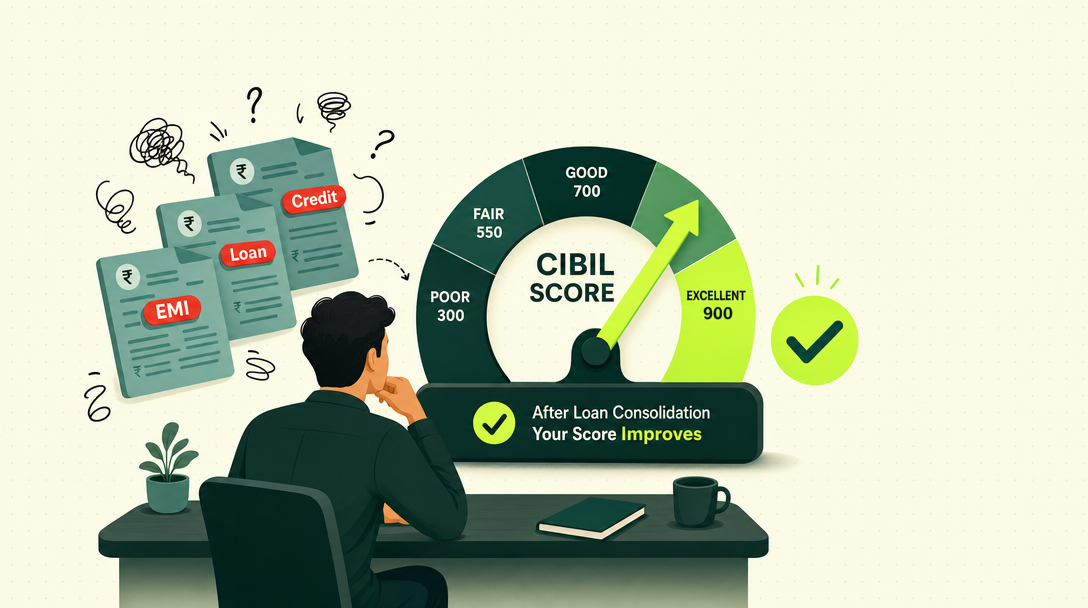
One of the most common questions borrowers ask before doing a loan consolidation is: “Will this hurt my CIBIL score?” It’s the right question to ask. The honest answer is: it depends on which part of the process you’re looking at and over what timeframe.
The short-term and long-term effects on your CIBIL score are quite different. This guide separates them clearly so you can make an informed decision.
How CIBIL Scores Are Calculated
Understanding the impact of loan consolidation on your score requires knowing what drives that score in the first place. CIBIL scores (ranging from 300 to 900) are determined primarily by five factors:
Loan consolidation touches at least four of these five factors. That’s why understanding the sequence of events matters.
The Short-Term Impact of Loan Consolidation
When you apply for a consolidation personal loan, the lender runs a hard inquiry on your CIBIL. This immediately drops your score by 5–10 points. It’s a temporary, minor decline — but it’s visible to other lenders for up to 12 months.
Once the loan is approved and disbursed, and you use it to foreclose existing loans:
- Old accounts are marked “Closed,” which is a positive status
- Your number of active loan accounts drops, which can slightly reduce your credit mix score
- Your credit card balances (if cleared) drop your credit utilization ratio significantly, which is a positive signal.
Net effect in months 1–3 after consolidation: score may dip slightly (5–15 points) due to the hard inquiry and reduction in active accounts, but credit utilization improvement can offset some of this.
The Long-Term Impact of Loan Consolidation
The medium to long-term picture is almost always positive, provided you make consolidated loan EMI payments consistently:
- Every on-time EMI payment strengthens your payment history — the highest-weighted factor
- Closed credit card accounts (not in revolving debt) show zero utilization — positive
- A single active installment loan with a good payment record is a clean, positive credit signal
- Your FOIR improves as old debts close, making you a better candidate for future borrowing
Most borrowers who complete loan consolidation and maintain clean repayment see their CIBIL scores return to pre-consolidation levels within 3–6 months and often reach higher scores within 12 months.
What “Closed” vs “Settled” Means on Your Report
This distinction is critical when thinking about loan consolidation :
When you pay off an existing loan in full (as happens during consolidation), the account status on your CIBIL report changes to “Closed.” This is a positive status — it signals you fulfilled your obligation completely.
A “Settled” status, by contrast, means you negotiated to pay less than the full amount. It is a negative marker that stays on your CIBIL report for 7 years and significantly restricts your future credit access.
Loan consolidation, correctly executed, results in “Closed” status on all foreclosed accounts. This is fundamentally different from debt settlement and should not be confused with it.
How to Protect Your CIBIL Score During Consolidation
Five actions that preserve and improve your CIBIL score through the loan consolidation process:
- Apply to one lender at a time. Each application is a hard inquiry. Compare lenders using soft inquiries first, then apply to your top choice.
- Don’t close old credit card accounts immediately. Surprisingly, keeping old credit card accounts open (with zero balance) maintains your average credit age and keeps your utilization ratio low — both CIBIL positives.
- Set up auto-debit immediately. The new consolidation loan EMI must never be missed. A single 30-day late payment can drop your score by 50–100 points.
- Wait 3 months before applying for any new credit. Let the consolidation settle, the old accounts show as closed, and your score recovers before any additional credit inquiries.
- Monitor your CIBIL report monthly. Ensure foreclosed accounts are correctly marked “Closed” and not left in an ambiguous status by the old lender.
Common Mistakes That Damage CIBIL During Consolidation
Applying to 4–5 lenders simultaneously. This results in multiple hard inquiries in a short window — a pattern lenders associate with credit stress, even if it’s just comparison shopping. Each inquiry can cost you 5–10 points.
Using cleared credit cards immediately. After loan consolidation clears your credit card balance, your utilization drops to zero — a CIBIL positive. Running up the card again immediately negates this benefit and creates new debt on top of the consolidation loan.
Missing the new EMI due to disbursement timing. If the consolidation loan disbursement and first EMI due date are close together, ensure your bank account has sufficient funds. The first missed EMI on a new loan is particularly visible to future lenders.
- Loan consolidation causes a temporary 5–15 point CIBIL dip due to the hard inquiry and reduced active accounts — this is normal and recovers within 3–6 months.
- Long-term CIBIL impact is positive: consistent repayment of the new single EMI and cleared credit utilization both strengthen the score.
- Consolidated loans close old accounts as “Closed” — a positive CIBIL status. This is fundamentally different from “Settled.”
- Keeping old credit cards open at zero balance (after clearing them) maintains credit age and low utilization — both CIBIL positives.
- Never miss the new EMI. A single late payment on the consolidation loan can drop your score by 50–100 points.
FAQs
There is a temporary dip of 5–15 points from the hard inquiry and a reduction in active accounts. However, over 6–12 months of consistent consolidated loan repayment, your score typically returns to and exceeds its pre-consolidation level, especially if credit card balances were part of the consolidation.
The hard inquiry from the application shows on your CIBIL report for 12 months, but has a diminishing impact after 3 months. Closed accounts (old loans paid off via consolidation) remain on your report positively for 7 years.
Yes, typically. Provided you’ve maintained consistent repayment on the loan consolidation personal loan and your CIBIL score has recovered to 700+, most home loan lenders will consider your application. Your FOIR with the consolidation loan EMI must fit within the home loan eligibility limits.
There is a temporary dip of 5–15 points from the hard inquiry and a reduction in active accounts. However, over 6–12 months of consistent consolidated loan repayment, your score typically returns to and exceeds its pre-consolidation level, especially if credit card balances were part of the consolidation.
The hard inquiry from the application shows on your CIBIL report for 12 months, but has a diminishing impact after 3 months. Closed accounts (old loans paid off via consolidation) remain on your report positively for 7 years.
Conclusion
The CIBIL score impact of loan consolidation is temporary and manageable — and for most borrowers, net positive over 12 months. The conditions that create a positive outcome are straightforward: apply to one lender, set up auto-debit, don’t re-use cleared cards, and monitor your CIBIL report to ensure old accounts are correctly marked. The score worry should not deter a financially sound consolidation decision.