





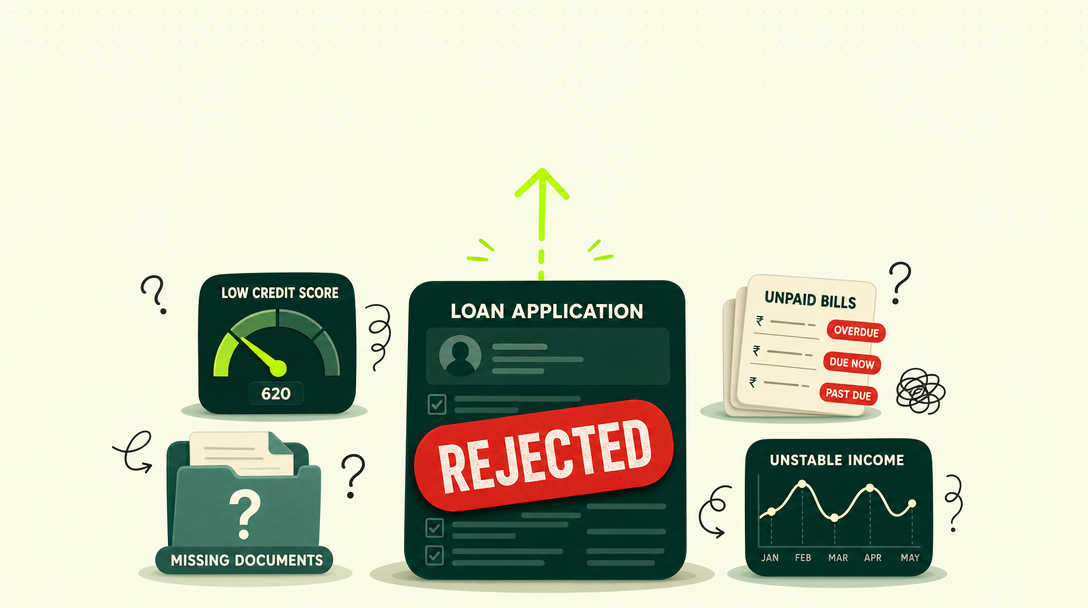
A personal loan application rejected by a bank or NBFC does not necessarily indicate a poor credit history. In 2026, lenders in India reject applications for multiple reasons, including high FOIR, unstable employment, excessive hard enquiries, and repayment capacity concerns.
The reasons for rejection that lenders communicate (when they communicate at all) are often generic. The actual underwriting logic is more specific. This guide covers the eight real reasons personal loan applications are declined in India, with specific corrective actions for each.
Why Personal Loan Application Rejection Cases Are Increasing
Banks and NBFCs are not legally required to provide detailed rejection reasons. The standard rejection letter references ‘credit policy criteria’ without identifying which criterion was not met. This is partly to protect proprietary underwriting logic, and partly because automated credit models produce binary outcomes without always pinpointing a single failure point.
The practical consequence: borrowers reapply to the same lender without addressing the root cause, generate additional hard enquiries, and progressively reduce their CIBIL score. Understanding the likely rejection reason from the lender’s perspective rather than waiting for an explanation is the only reliable strategy.
Reason 1: CIBIL Score Below the Lender’s Threshold
Every lender has a minimum CIBIL score threshold. These are not universally disclosed, but industry practice in 2026 is approximately:
- Private banks (HDFC, ICICI, Kotak): 720–740 minimum
- PSU banks (SBI, Bank of Baroda): 680–700 minimum
- NBFCs (Poonawalla, Bajaj Finserv): 650–680 minimum
A 690 CIBIL score will be rejected by most private banks but approved by certain NBFCs. The issue is not the score itself; it is applying to the wrong lender for that score.
Fix: Pull your credit report, confirm your score, and apply only to lenders whose published or known minimum threshold is below your current score. TapTap’s soft assessment identifies this match before any application is submitted.
Reason 2: FOIR Exceeds the Permissible Limit
FOIR (Fixed Obligation to Income Ratio) measures your existing EMI burden relative to income. Most lenders cap permissible FOIR at 50–55% of net monthly income. The proposed new loan EMI is included in this calculation.
A borrower earning Rs. 60,000 per month with existing EMIs of Rs. 28,000 has a base FOIR of 47%. Adding a proposed personal loan EMI of Rs. 8,000 pushes FOIR to 60%, above the permissible limit for most lenders. The loan is rejected despite adequate income and a good credit score.
Fix: Reduce existing EMI obligations before applying. Foreclosing one small consumer durable loan or making a significant credit card payment can shift FOIR below the threshold. Alternatively, apply for a smaller loan amount that generates a lower EMI within the permissible FOIR.
Reason 3: Employer Not on the Approved List
Private sector banks maintain whitelist databases of approved employers. If your company is not on the list because it is small, recently incorporated, or unrated, the application may be declined regardless of your CIBIL score or income.
This is especially common with HDFC Bank and Kotak Mahindra Bank, which maintain strict employer eligibility criteria. Axis Bank and ICICI Bank have slightly more inclusive lists.
Fix: Apply to an NBFC (which has less restrictive employer requirements) or to a bank that specifically serves your employer tier. Alternatively, apply with a co-applicant who works at a whitelisted employer.
Reason 4: Income Below the Minimum Threshold
Most banks have a minimum net monthly income requirement of Rs. 25,000 for personal loan eligibility in metro cities; Rs. 20,000 in non-metro locations. NBFCs are more flexible at Rs. 15,000–20,000. Self-employed borrowers face different income thresholds.
A borrower earning Rs. 22,000 net monthly in Bengaluru may not meet a particular bank’s minimum income requirement, even with a strong CIBIL score.
Fix: Apply to lenders with income criteria appropriate for your income level. For income below Rs. 25,000, NBFC lenders are the appropriate target market.
Reason 5: Recent Job Change or Employment Gap
Most lenders require a minimum of 1 year with the current employer and 2 years of total work experience. A job change within the past 6 months, even to a higher-paying role, can trigger rejection because the new employment is unverified and probation periods create income uncertainty.
An employment gap of more than 3 months in the past 2 years can also trigger rejection or a higher rate at risk-averse lenders.
Fix: Wait 6 months after a job change before applying. If you have recently changed jobs and urgently need credit, apply to NBFCs that use bank statement income verification rather than employment tenure as the primary underwriting signal.
Reason 6: Existing Delinquency or Default Record
Any account on your CIBIL report marked as ‘overdue,’ ‘written off,’ or ‘settled’ acts as a significant negative signal. Even a 30-day late payment from 18 months ago can affect approval at risk-averse, conservative lenders.
More seriously, if you have a loan account that was settled (where the lender accepted less than the full outstanding amount), this appears on your report and will cause rejection at banks. NBFCs with higher risk tolerance may still consider such profiles.
Fix: Resolve any outstanding delinquencies before applying. Pay overdue amounts in full where possible; a ‘closed’ status is significantly better than ‘settled’ on a credit report. Allow 6–12 months of positive payment history after resolution before applying to a mainstream bank.
Reason 7: Incomplete or Inconsistent Documentation
Banks reject applications where submitted documents contain inconsistencies: a name on the PAN card that does not match the Aadhaar, a mobile number that does not match the registered mobile with the bank, or salary slips that show a different employer name than the address proof.
Incomplete submissions, such as a salary slip for 2 months when 3 are required, or a bank statement with missing pages, cause delays that often convert to rejections if not resolved within the lender’s processing window.
Fix: Review all documents for consistency before submission. Names, dates of birth, and mobile numbers must be identical across all identity documents and financial records.
Reason 8: Multiple Recent Credit Enquiries
Every loan application generates a hard enquiry. Three or four applications within 30 days, common among borrowers who apply to multiple lenders simultaneously, create an enquiry cluster that signals financial distress to underwriting models. The score impact of each enquiry is 5–10 points, but the clustering signal is treated more severely than the cumulative score reduction.
Fix: Stop applying immediately after a rejection. Allow 3–6 months for the enquiry cluster to age before reapplying, and identify the root cause of rejection before any new application.
What to Do After a Rejection
The post-rejection protocol:
- Do not reapply to any lender immediately. Every application is another hard enquiry.
- Pull your full CIBIL report within 7 days of rejection. Look for errors, outstanding delinquencies, and your current score.
- Identify the likely rejection reason using the framework above.
- Take corrective action to reduce FOIR, settle overdue accounts, and wait out an employment tenure requirement.
- After 3–6 months, engage TapTap Loans for a soft-assessment profile review. The platform will identify which lenders will consider your current profile before any application is submitted.
Key Takeaways
- Most personal loan rejections are preventable with profile pre-assessment before applying.
- The biggest rejection drivers are CIBIL score, FOIR, and employer category — in that order.
- Each rejection generates a hard inquiry that further suppresses your score. Resolve the root cause before reapplying.
- Applying to the right lender for your profile, not the lender with the most advertising, is the practical solution to rejection cycles.
Frequently Asked Questions
At a minimum of 3 months. Ideally, 6 months, combined with specific corrective action on the rejection reason. Reapplying immediately to multiple lenders generates a cluster of hard enquiries that makes the next approval progressively harder.
The rejection itself does not appear. The hard enquiry triggered by the application does appear and is visible to all lenders. Multiple enquiries without a resulting approved loan are a signal that lenders read as credit distress.
Formally, banks have internal grievance mechanisms. Practically, an appeal without addressing the underlying rejection reason is unlikely to succeed. A better approach is a fresh application to a more suitable lender after corrective action.
A good CIBIL score alone does not guarantee approval. Banks also evaluate FOIR, income stability, employer category, existing EMIs,s and recent hard enquiries before approving a personal loan application.
To improve approval chances after a personal loan application rejection, reduce existing EMIs, avoid multiple loan applications, improve your CIBIL score, and apply to lenders that match your income and employment profile.
Conclusion
A personal loan rejection is most useful when treated as diagnostic data rather than a final verdict. Each of the eight reasons in this guide corresponds to a specific corrective action, and most of those actions are achievable within 60–90 days.
The critical discipline is not applied during this correction period. Every hard enquiry costs you credit score points you cannot afford when you are already managing a rejection. TapTap Loans’ soft-assessment model exists precisely for this reason: to identify the right lender for your current profile before the hard enquiry is triggered.