





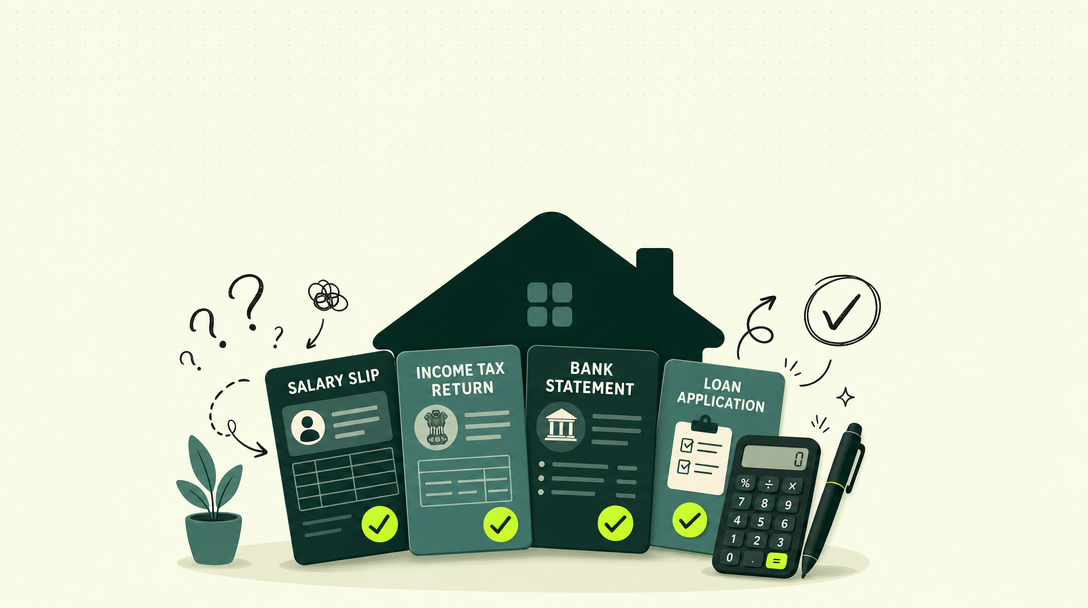
Home loan documents required fall into four groups. KYC, income proof, property papers, and bank statements. The exact list differs for salaried and self-employed applicants. This guide covers both in full.
KYC Documents, Common for All Applicants
- PAN card
- Aadhaar card
- Passport-size photographs
- Address proof, if different from Aadhaar
These are needed regardless of your employment type. Keep certified copies ready, since most lenders want originals for verification too.
Documents for Salaried Applicants
- Salary slips, last 3 to 6 months
- Form 16, for the last 2 years
- Bank statements, 6 months, showing salary credits
- Employment proof, an offer letter or employment certificate
Salaried applications tend to move faster, since this documentation is straightforward to verify.
Documents for Self-Employed Applicants
- Income Tax Returns, 2 to 3 years
- GST returns, if applicable
- Bank statements, 6 to 12 months, both personal and business accounts
- Business proof, registration certificate, or partnership deed
- Audited financial statements, for larger loan amounts
Self-employed applications typically take a bit longer to verify, given the additional documents involved.
Property Documents Required
- Sale agreement
- Title deed, showing clear ownership history
- Approved building plan
- No Objection Certificate from the builder or housing society
- Encumbrance certificate, confirming no existing loans against the property
These documents let the lender independently verify the property’s legal standing before sanctioning your loan.
Additional Documents for Co-Applicants
If you’re applying with a co-applicant, they’ll need to submit their own KYC and income documents too. This applies whether they’re a spouse, parent, or sibling. Adding a co-applicant with strong documentation can meaningfully improve your combined eligibility.
A Quick Comparison Table
| Document Type | Salaried | Self-Employed |
|---|---|---|
| Income proof | Salary slips, Form 16 | ITR, GST returns |
| Bank statements | 6 months | 6-12 months |
| Business proof | Not required | Registration certificate |
| Employment proof | Offer letter | Business continuity proof |
Common Documentation Errors That Delay Approval
Mismatched names across documents. A minor spelling difference between your PAN and Aadhaar can trigger delays.
Outdated bank statements. Always submit the most recent period asked for, not an older set you happen to have on hand.
Incomplete property documents. Missing even one document in the chain of title can hold up the entire application.
Inconsistent income figures. Your declared income should match what’s shown across your salary slips, bank statements, and ITR, if applicable.
How to Prepare Before You Apply
Gather your KYC documents first, since these rarely change. Then pull your most recent income documents, salary slips or ITR, depending on your employment type. Finally, confirm your property documents are complete, ideally with your builder or seller’s help, before submitting your full application.
Having everything organized in one folder, rather than scrambling as each document is requested, speeds up approval significantly.
What Happens If a Document Is Missing
Most lenders will flag a missing document and pause your application until it’s submitted, rather than reject you outright. This can add days or weeks to your timeline, which is exactly why preparing everything upfront matters.
Frequently Asked Questions About Home Loan Documents
Salary slips for the last 3-6 months, Form 16 for 2 years, 6 months’ bank statements, and standard KYC documents.
Most lenders ask for 2-3 years of ITR, along with GST returns where applicable and business proof.
Sale agreement, title deed, approved building plan, NOC from the builder or society, and an encumbrance certificate.
Yes, co-applicants aren’t mandatory, though adding one with high income can improve your eligible loan amount.
Ready to start your home loan application? Check your eligibility with TapTap; we’ll tell you exactly what documents you need for your specific lender match