





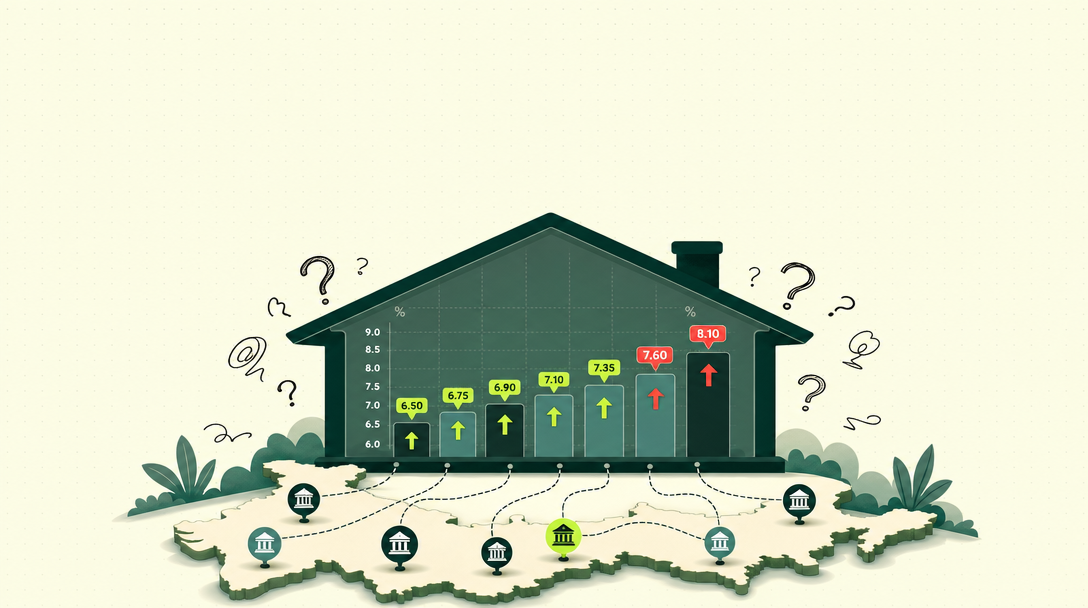
Home loan interest rates in India currently range from roughly 8.25% to 11%, depending on your lender, credit score, and loan amount. This guide breaks down what drives that range, and how to get closer to the lower end.
Why the Rate You’re Offered Isn’t the Rate You See Advertised
Banks advertise a “starting from” rate. Very few borrowers actually get it. That headline number usually applies only to applicants with a near-perfect credit score, a large down payment, and a straightforward salaried income.
Your real rate depends on your specific profile. Understanding what moves it helps you negotiate, or shop, more effectively.
Bank vs NBFC: A Quick Comparison
| Lender Type | Typical Rate Range | Processing Speed | Best For |
|---|---|---|---|
| Public sector banks | 8.25%-9.5% | Slower | Strong salaried profiles, best rates |
| Private banks | 8.5%-10% | Moderate | Balance of speed and rate |
| Housing finance companies | 9%-11% | Faster | Self-employed, flexible documentation |
Rates shift with RBI policy changes, so always confirm current numbers directly with the lender before applying.
How Your Credit Score Changes Your Rate
This is the single biggest lever most borrowers overlook. A 750+ score can unlock rates near the bottom of the range. A score in the 650-700 band often means a meaningfully higher rate, sometimes a full percentage point or more.
Before applying, check your score. If it’s below 750, consider spending a few months improving it before locking in a 20-year loan.
Fixed vs Floating: Which Costs Less Long-Term?
Floating rates move with the market, tied to the RBI repo rate. They’re more common in India, and the RBI bans foreclosure charges on floating-rate home loans for individual borrowers, giving you flexibility to prepay or switch later.
Fixed rates lock in a rate for a period, offering predictability. They usually start slightly higher, and won’t benefit if market rates fall.
Over a typical 15-20 year tenure, floating rates have historically worked out cheaper for most Indian borrowers, though this isn’t guaranteed for every rate cycle.
What Else Affects Your Rate, Beyond Credit Score
Your down payment size matters. A larger down payment reduces the lender’s risk and can unlock a better rate. Your income stability matters too. A longer, more consistent employment or business history signals lower risk.
The property itself plays a role. Some lenders price ready-to-move properties slightly differently than under-construction ones, given the different risk profile involved.
How to Negotiate a Better Rate
Check your eligibility across multiple lenders before committing to one. A competing offer, even informally mentioned, sometimes gives your preferred lender room to match or beat it.
Ask specifically about any relationship discount, if you already bank with that institution. And time your application for when your credit score and documentation are at their strongest.
A Worked Example
Say you’re borrowing ₹60,00,000 over 20 years. At 8.5%, your EMI is roughly ₹52,000. At 9.5%, it climbs to about ₹56,000. That one percentage point difference costs an extra ₹4,000 a month, and well over ₹9 lakh in additional interest across the full tenure.
This single number is why comparing rates across lenders, rather than accepting the first offer, matters so much on a loan this size.
When to Lock In a Rate vs Wait
If rates are trending downward, some borrowers wait, hoping for a better deal. This can backfire if rates reverse. A more reliable approach: lock in the best rate you can find today, and use the RBI’s floating-rate foreclosure exemption to switch later if rates genuinely improve.
How Often Should You Check Your Rate After Taking the Loan?
Your home loan rate isn’t fixed for life, even on a “fixed” product past its lock-in period. Check your rate against the current market roughly once a year. If a meaningful gap has opened up, a balance transfer could be worth exploring.
Frequently Asked Questions About Home Loan Interest Rates in India
Rates currently start around 8.25% for the strongest profiles at select public sector banks, though your actual offer depends on your credit score, income, and loan amount.
This changes over time and by profile. Public sector banks often lead on headline rates, but private banks and NBFCs can be more competitive for specific borrower types. Always compare current offers directly.
Often, yes. A larger down payment reduces the lender’s risk, which can translate into a marginally better rate, alongside a smaller loan amount overall.
Floating rates are more common in India and typically cheaper over a long tenure, with the added benefit of no foreclosure charges for individual borrowers. Fixed rates offer predictability at a usually higher starting cost.
Want to see what rate you could actually qualify for? Check your eligibility with TapTap across multiple lenders, with zero impact on your credit score.