





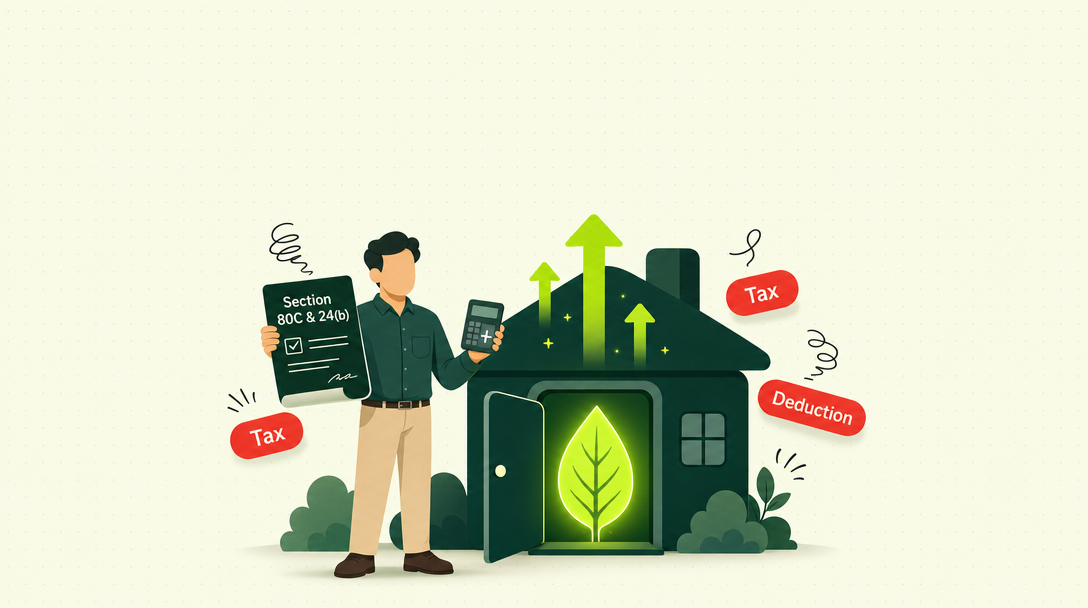
Home loan tax benefits in India come mainly from two sections. Section 80C, up to ₹1.5 lakh on principal repayment. Section 24(b), up to ₹2 lakh on interest paid, for a self-occupied property. This guide breaks down both, with a worked example.
Section 80C: Principal Repayment Deduction
Under Section 80C, you can claim a deduction of up to ₹1.5 lakh per year, on the principal portion of your home loan EMI. This limit is shared with other 80C investments, PF, ELSS, life insurance premiums, so your total claim across all of these combined cannot exceed ₹1.5 lakh.
Section 24(b): Interest Deduction
Under Section 24(b), you can claim up to ₹2 lakh per year on the interest portion of your home loan EMI, for a self-occupied property. This is a separate limit from 80C, so both deductions can be claimed together.
For a rented-out property, there’s no upper cap on the interest deduction, though the total loss you can set off against other income in a given year is capped at ₹2 lakh, with the remainder carried forward.
Additional Benefit Under Section 80EEA
First-time home buyers, meeting specific conditions around property value and loan amount, may be eligible for an additional deduction under Section 80EEA, on top of the standard 24(b) limit. Eligibility criteria and limits change periodically, so confirm current applicability with a tax advisor before assuming you qualify.
Joint Home Loan Tax Benefit
If you take a home loan jointly, with a spouse or family member as co-applicant and co-owner, each of you can claim these deductions separately, on your own share of the EMI. This effectively doubles your combined tax benefit, a meaningful reason many couples choose to apply jointly.
A Worked Example
Say your annual EMI outflow is ₹6,00,000, split roughly ₹2,00,000 toward principal and ₹4,00,000 toward interest. You can claim the full ₹1.5 lakh under 80C, and the full ₹2 lakh under 24(b), for a combined ₹3.5 lakh in deductions, assuming you haven’t exhausted your 80C limit elsewhere.
Apply this jointly with a co-applicant, and your household could potentially claim close to double this amount, depending on how the EMI and ownership are split.
Old Tax Regime vs New Tax Regime
This matters significantly. Home loan interest and principal deductions under 80C and 24(b) are generally available only under the old tax regime, for a self-occupied property. The new tax regime, with its lower slab rates, doesn’t allow most of these deductions.
Before choosing a tax regime, calculate both scenarios with your specific numbers, since the better choice depends heavily on how much you’re claiming through home loan and other deductions.
Common Mistakes That Reduce Your Tax Benefit
Not separating the principal and interest components correctly when filing. Forgetting that a rented property has different interest-deduction rules than a self-occupied one. And assuming both spouses automatically get the deduction, without confirming that both are co-owners and co-borrowers, which is required to claim it individually.
How to Claim These Deductions
Your lender provides an annual interest certificate, breaking down your principal and interest paid for the financial year. Use this directly when filing your return, in the specific sections for 80C and 24(b) deductions.
Frequently Asked Questions
Up to ₹1.5 lakh under Section 80C for principal, and up to ₹2 lakh under Section 24(b) for interest, for a self-occupied property. Combined, that’s up to ₹3.5 lakh in annual deductions.
Generally no, for a self-occupied property. Most home loan deductions are available primarily under the old tax regime.
Yes, provided both are co-owners and co-borrowers on the loan. Each can claim deductions on their own share of the EMI.
Yes. There’s no upper cap on the interest deduction for a rented property, though the loss you can set off against other income in a given year is capped, with the remainder carried forward.
Want to see how a home loan fits your overall finances? Compare your options with TapTap across 20+ lenders.