





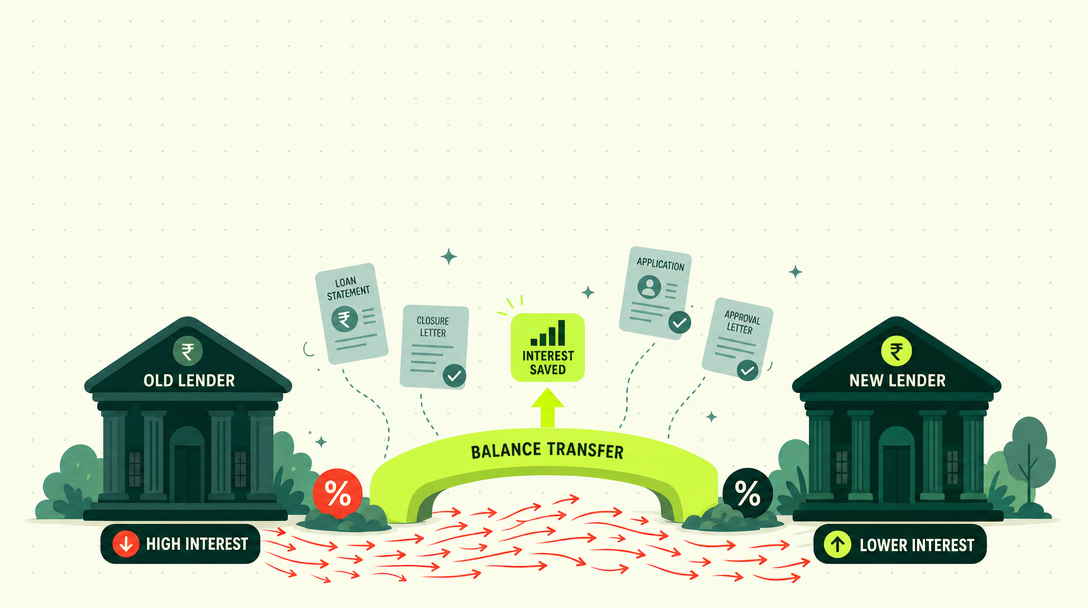
A personal loan balance transfer lets you move your existing personal loan to a new lender offering a lower interest rate. The new lender pays off your remaining balance with your current lender, and you continue repaying the loan at the new, lower rate or the remaining tenure. It’s essentially refinancing: same debt, better terms.
This matters more than most borrowers realize, because personal loan rates aren’t static t; they’re priced against your credit profile at the time you applied. If your CIBIL score has improved since then, or if the lending market has become more competitive, you may well be paying a rate today that no longer reflects your actual creditworthiness.
When It Makes Sense
Balance transfer is worth pursuing when:
- Your CIBIL score has risen meaningfully since you took the original loan; a jump from, say, 680 to 760 can unlock a materially better rate.
- You’re currently paying a rate that’s 1.5–2 percentage points or more above what you could qualify for elsewhere; the gap needs to be large enough to outweigh transfer fees.
- You have a reasonable amount of tenure remaining;g transferring with only a few months left rarely saves enough to justify the fees involved.
- Interest rates in the broader market have fallen since you took the loan, and new lenders are competing more aggressively for good-credit borrowers.
What Actually Changes When You Transfer?
It helps to be precise about what a balance transfer does and doesn’t change. Your loan amount (outstanding principal) stays the same; you’re not borrowing more or being handed extra cash. What changes is the lender, the interest rate, and potentially the tenure if you choose to restructure it during the transfer. Some borrowers use the transfer as an opportunity to also shorten their tenure (since a lower rate can support a shorter payoff period at a similar or even lower EMI), which reduces total interest paid even further than the rate cut alone would suggest. Others extend the tenure to lower the immediate EMI a reasonable choice if cash flow is tight, though it’s worth remembering this can increase total interest paid despite the lower rate, so it’s a genuine trade-off rather than a pure win.
Step-by-Step Transfer Process
- Check your current loan details — outstanding principal, current rate, remaining tenure, and any prepayment/foreclosure charge from your existing lender.
- Check your updated CIBIL score and compare potential offers across multiple lenders.
- Apply to the new lender, who evaluates your profile and the existing loan, and offers a new rate.
- The new lender pays off your existing loan directly upon approval.
- You begin repaying the new lender at the new rate for the remaining (or restructured) tenure.
When It Doesn’t Make Sense
Balance transfer isn’t automatically beneficial. It typically doesn’t help when your existing rate is already competitive for your credit profile, when you have very little tenure remaining (under 6-12 months), when the new lender’s processing fee would consume most of the interest savings, or when your credit score has actually declined since you took the original loan in which case a new lender may only offer you a similar or worse rate than what you’re currently paying. Always run the numbers before assuming a transfer will help; a lower advertised “starting from” rate doesn’t guarantee it’s the rate you’ll actually be offered.
Fixed vs Floating Rate Considerations
If your existing personal loan is on a floating rate, remember that RBI rules already prohibit foreclosure charges on it for individual, non-business borrowers, meaning you can prepay or transfer without that specific cost. If it’s a fixed-rate loan, check your loan agreement for the foreclosure charge, typically 2-5% of the outstanding principal, and factor this directly into your savings calculation before proceeding. This single detail can be the difference between a transfer that clearly pays off and one that barely breaks even.
Documents Required
- KYC: PAN, Aadhaar
- Latest loan statement or foreclosure letter from your existing lender
- Income proof: salary slips and bank statements (salaried) or ITR and bank statements (self-employed)
- Updated CIBIL report (often pulled directly by the new lender via soft inquiry)
Foreclosure & Processing Charges
Two sets of charges affect the final math:
- Foreclosure charge from your existing lender — under RBI rules, banks and NBFCs cannot levy foreclosure or prepayment charges on floating-rate personal loans to individual borrowers for non-business purposes. Fixed-rate loans, however, may still carry a charge, typically 2–5% of the outstanding principal. Always confirm which type your existing loan is.
- Processing fee on the new loan, typically 0.5–2% of the transferred amount.
Real Savings Example
Suppose you took a ₹4,00,000 personal loan two years ago at 17% p.a. for a 5-year tenure. Your CIBIL score has since improved from 690 to 770, and you’re now offered a balance transfer at 11% p.a. for the remaining 3 years.
At the original 17% rate, your remaining EMI on the outstanding balance would continue at a higher monthly cost. Switching to 11% p.a. can lower your EMI by roughly 15–20% and meaningfully reduce total interest paid over the remaining tenure even after accounting for a processing fee of around 1% on the new loan. The exact saving depends on your outstanding balance and remaining months, which is why running the numbers before switching (rather than assuming a lower advertised rate automatically means savings) matters.
How TapTap Finds You the Best Rate
Rather than approaching one bank at a time — each application potentially triggering its own credit inquiry TapTap assesses your updated profile against 20+ banks and NBFCs simultaneously through a soft credit check that doesn’t affect your score. We identify which lender is most likely to both approve you and offer the best available rate for your specific profile, then handle the documentation and lender follow-up directly.
Frequently Asked Questions
Yes, personal loan balance transfer is available at any point during your loan tenure, though it’s typically most worthwhile with meaningful tenure remaining, so the interest savings have time to outweigh transfer costs.
This varies by lender, but many require at least 12 months of remaining tenure to consider a balance transfer application, since the fees involved need enough runway to be worth it.
There’s a small, temporary dip from the new lender’s credit inquiry. Over time, consistent on-time payments on the new loan tend to support your score positively, the same as any other well-managed credit account.
Savings depend on the gap between your current rate and the new offered rate, your outstanding balance, and remaining tenure. A 3–5 percentage point rate reduction on a mid-size loan with 2+ years remaining commonly saves tens of thousands of rupees in total interest.
Largely yes, a balance transfer involves the new lender assessing you as if you were a fresh applicant, including income verification and a credit check, even though the funds are used to pay off an existing loan rather than for a new purpose. The good news is that if your profile has genuinely improved since your original loan, this fresh assessment is exactly what unlocks the better rate.
Most lenders prefer to see at least a few months, commonly 6-12 months, of established repayment history on your existing loan before approving a transfer, partly to assess your payment consistency and partly because very early transfers generate limited interest savings relative to the fees involved.
Want to know your exact savings? Use TapTap’s free savings calculator to check your new EMI in minutes, with zero impact on your credit score.