





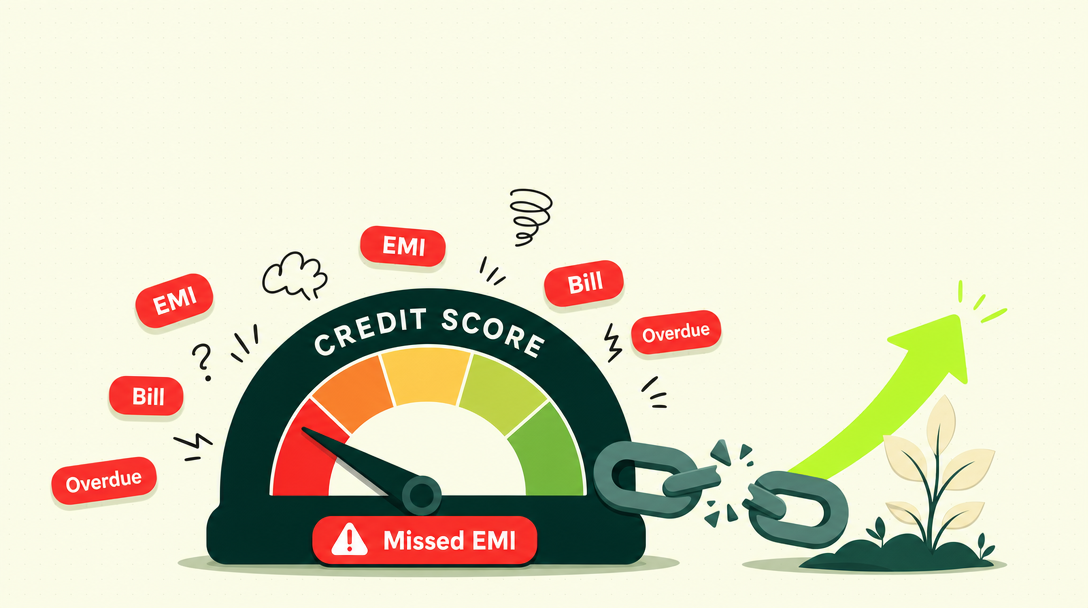
A single missed EMI that gets reported to credit bureaus can drop your CIBIL score by roughly 50 to 100 points, depending on your existing score, credit history length, and how many days the payment stayed overdue before being cleared. The good news: this impact is generally recoverable within 6–12 months of consistent, on-time payments afterward; it’s rarely permanent, but it isn’t instant to fix either.
How CIBIL Calculates Payment History Weightage
Payment history is the single largest factor in your CIBIL score calculation, typically carrying more weight than any other component, more than credit utilization, credit mix, or the length of your credit history combined. This is precisely why a missed payment hits harder, proportionally, than most other credit missteps. CIBIL tracks payment status month by month across every reported credit account, and even one missed payment creates a visible gap in an otherwise clean record.
Points Lost for a Single Missed EMI
The exact point drop varies by individual profile, but general patterns hold:
- Borrowers with a strong existing score (750+) and long clean history tend to see a smaller percentage drop but a larger absolute point loss, since they have more score to lose
- Borrowers with a shorter credit history or an already-moderate score can see a proportionally larger relative impact, since each data point carries more weight in a thinner credit file
- The severity of the miss matters;s a payment resolved within days behaves very differently from one reported at 60 or 90 days overdue
30, 60, 90-Day DPD Explained
DPD stands for “Days Past Due” and is the standard measure lenders and bureaus use to track overdue payments:
- DPD 0-30: Recently overdue; least damaging if resolved quickly
- DPD 30-60: Meaningfully overdue; clearly visible negative mark
- DPD 60-90: Seriously overdue; substantial score impact and heightened lender scrutiny
- DPD 90+: Classified as NPA (Non-Performing Asset) under RBI norms — the most severe classification, with the longest-lasting credit impact
Each escalation in DPD status typically corresponds to a larger, more persistent score impact.
How Long the Impact Stays on Your Report?
A missed payment record generally remains visible on your credit report for a period commonly cited as around 7 years internationally, though Indian bureau retention practices vary and specific line items age out of scoring relevance faster than they disappear from the raw report. In practice, the scoring impact fades significantly faster than the visibility of a single old missed payment from years ago; consistent on-time payments since carry far less weight than a recent one.
Why Payment History Outweighs Other Factors?
It’s worth understanding why a missed payment hits disproportionately hard compared to, say, applying for a new credit card or carrying a moderate balance. Credit scoring models are built primarily to predict future repayment risk, personal loan eligibility factors, and the single strongest predictor of whether someone will miss a future payment is whether they’ve missed one before. This is why payment history typically carries more scoring weight than credit mix, new credit inquiries, or even credit history length; a single data point of “this person didn’t pay on time” is treated as more informative than almost anything else in the file, which is exactly why the recovery process, while real, takes sustained months of clean history rather than a quick fix.
Comparing a Single Miss vs a Pattern of Misses
The scoring impact of one isolated missed payment, promptly resolved, is meaningfully different from a pattern of repeated misses across several months. A single miss, especially if it’s your first, tends to be weighted less severely and recovers faster than a string of misses, which signals an ongoing repayment capacity problem rather than a one-off disruption. If you notice a pattern forming — not just one bad month, but EMIs becoming a recurring struggle that’s a strong signal to address the underlying cause (often simply too many EMI obligations relative to income), understand your FOIR rather than treating each miss as an isolated incident to firefight individually.
Does Checking Your Own Score Make It Worse?
A common source of confusion: checking your own CIBIL score, even frequently, does not hurt it. This is a “soft inquiry” and is treated entirely differently from a “hard inquiry” triggered when a lender checks your score as part of a loan or credit card application. In fact, regularly monitoring your own score after a missed payment is a sensible habit; it lets you track recovery progress objectively rather than guessing, and quickly catch any reporting errors that might be dragging your score down unnecessarily.
How Long Does the Score Recovery Actually Take?
While every profile is different, a reasonable general expectation is: noticeable partial recovery within 3-6 months of consistent on-time payments following the missed EMI, more substantial recovery by 6-12 months, and near-full recovery to your pre-miss trajectory by 12-24 months, assuming no further misses occur in that window. Borrowers with an otherwise long, clean credit history tend to recover somewhat faster than those with a shorter overall credit file, since a single miss represents a smaller fraction of their overall track record.
Step-by-Step Score Recovery Plan
- Clear the missed EMI and any associated charges immediately if you haven’t already.
- Don’t miss another payment; consistency going forward is the single biggest lever for recovery; even one additional miss significantly slows recovery.
- Keep credit utilization low on any credit cards, since this is the second-largest scoring factor and can help offset the payment history hit.
- Avoid applying for new credit for a few months, since each hard inquiry causes its own small, temporary dip that compounds with the existing damage.
- Check your loan eligibility without affecting CIBIL occasionally; a payment that was actually made on time gets incorrectly reported as missed; dispute any such errors directly with the bureau.
- Give it time: most borrowers see meaningful recovery within 6–12 months of clean payment history, with fuller recovery over 12–24 months.
How to Prevent Future Drops
The most durable prevention is structural, not just behavioural: if you’re managing multiple EMIs across different due dates, the odds of an occasional miss go up simply from the complexity of tracking several payments. Consolidating multiple EMIs into a single monthly payment, on a single date, removes much of that structural risk; there’s simply one thing to track and one date to protect, rather than several.
Frequently Asked Questions
Commonly cited estimates range from 50 to 100 points for a single reported missed payment, though the exact number depends on your starting score, credit history length, and how overdue the payment became before resolution.
The record typically remains visible for several years, though its impact on your actual score diminishes progressively as you build a longer track record of on-time payments afterward.
Yes. Most borrowers see meaningful score recovery within 6–12 months of consistent on-time payments, with more complete recovery over 12–24 months, assuming no further missed payments occur.
Paying immediately limits further damage and starts the recovery clock, but it doesn’t erase the fact that a payment was missed; the record remains, though its weight on your score fades as you rebuild a clean payment history.
Struggling to keep track of multiple due dates? See how consolidating your EMIs into one payment could reduce your risk of a missed payment.