





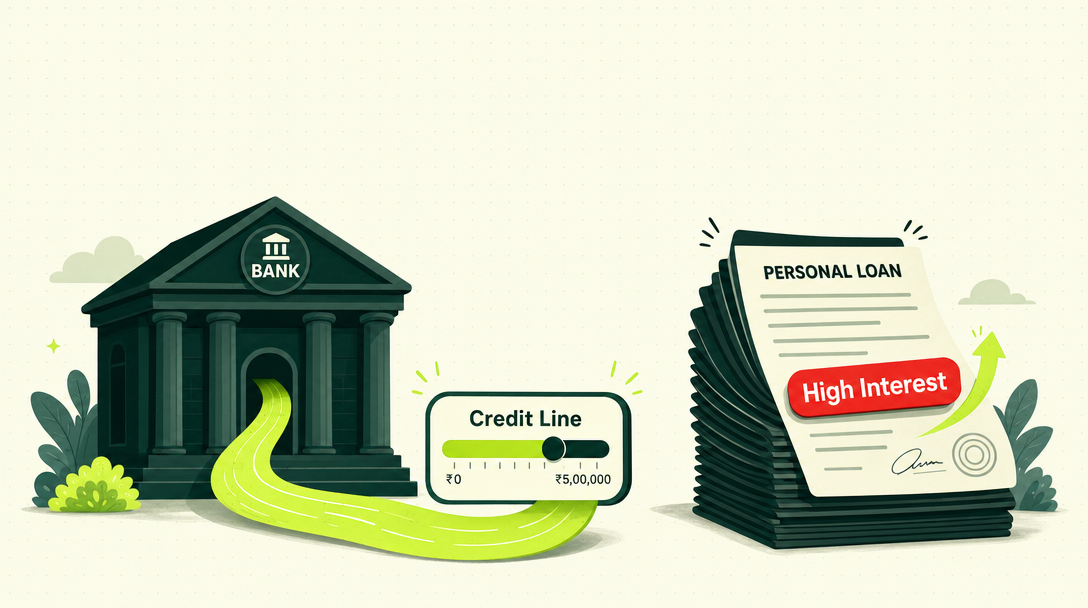
In a credit line vs personal loan comparison, a personal loan gives you a fixed amount upfront, repaid on a set schedule. A credit line gives you ongoing, flexible access to funds, up to a limit, that you can draw from repeatedly. This guide compares both.
What Is a Personal Loan?
A one-time disbursal of a fixed amount. You repay it through equal monthly installments over an agreed tenure. Once fully repaid, the loan is closed. If you need funds again later, you apply again.
What Is a Credit Line?
An approved limit you can draw from whenever you need, repeatedly, without reapplying each time. As you repay what you’ve used, that amount becomes available again, similar to how a credit card works, but often with lower rates and higher limits.
A Quick Comparison Table
| Factor | Personal Loan | Credit Line |
|---|---|---|
| Disbursal | One-time, full amount | Draw as needed, repeatedly |
| Interest charged on | The full amount, from day one | Only what you’ve actually drawn |
| Repayment | Fixed EMI schedule | Flexible, within terms |
| Reapplication | Needed for future funds | Not needed, limit renews as you repay |
| Best for | One large, defined need | Ongoing or unpredictable needs |
Why Interest Calculation Differs So Much
This is the biggest practical difference. A personal loan charges interest on the full amount from the start, even if you don’t need all of it immediately. A credit line charges interest only on what you’ve drawn, which can mean a significantly lower cost if your need is spread out or uncertain.
A Worked Example
Need ₹5,00,000, but only ₹2,00,000 immediately, with the rest possibly needed over the next six months?
Personal loan route: You borrow the full ₹5,00,000 now, paying interest on the entire amount from day one, even the ₹3,00,000 you don’t need yet.
Credit line route: You draw ₹2,00,000 now, paying interest only on that amount. You draw more later, as needed, paying interest only from when each portion is actually used.
When a Personal Loan Makes More Sense
For a single, clearly defined expense, a wedding, a specific purchase, a personal loan’s simplicity and predictable EMI schedule work well. You know exactly what you owe, and exactly when it’ll be paid off.
When a Credit Line Makes More Sense
For ongoing or unpredictable needs, managing a business’s variable cash flow, or covering expenses that arise over time rather than all at once, a credit line’s flexibility and interest-only-on-usage structure is genuinely more cost-effective.
Eligibility Differences
Both typically assess your income, credit score, and existing obligations, similar to standard personal loan criteria. Credit lines sometimes favor applicants with an existing banking relationship, or those able to offer some form of security for a larger limit.
Does a Credit Line Affect Your Credit Score Differently?
It’s treated somewhat like a credit card in scoring terms. Your utilization, how much of your credit line you’re using relative to the full limit, matters, similar to card utilization. Keeping this reasonably low, alongside consistent repayment, supports a healthy score.
Can You Have Both at the Same Time?
Yes, and this isn’t unusual. Someone might have a personal loan for a specific past purchase, while also maintaining a credit line for ongoing flexibility. Each serves a different purpose, and having both isn’t inherently a problem, provided your total obligations stay manageable.
How to Decide Between the Two
Ask yourself: do I know exactly how much I need, and when? A personal loan fits this clean, defined scenario well. Is my need spread out, uncertain, or recurring? A credit line’s flexibility likely saves you money and hassle in this case.
Frequently Asked Questions
It can be, since you only pay interest on what you actually draw, not the full approved limit. For a need you’re certain about upfront, a personal loan’s fixed structure might still work out similarly, or better.
Many credit lines are reviewed periodically by the lender and can be renewed, adjusted, or, in some cases, withdrawn based on your ongoing profile and usage.
Some lenders offer this option, converting an outstanding credit line balance into a fixed-EMI loan, which can help if you want more repayment predictability.
Often a credit line, given typically variable cash flow needs, though this depends on the specific business and how predictable its funding needs actually are.
Yes. You can have both if you meet the lender’s eligibility criteria. Just make sure the combined EMIs and credit obligations remain manageable within your income.
Conclusion
Choosing between a credit line vs. a personal loan comes down to how you need the money. A personal loan is better for a one-time, planned expense with predictable EMIs. A credit line is more flexible for ongoing or uncertain needs because you pay interest only on the amount you actually use. Compare the interest rate, fees, repayment terms, and your expected usage before deciding which option costs less.
Not sure which structure fits your needs? Compare your options with TapTap across 20+ lenders.