





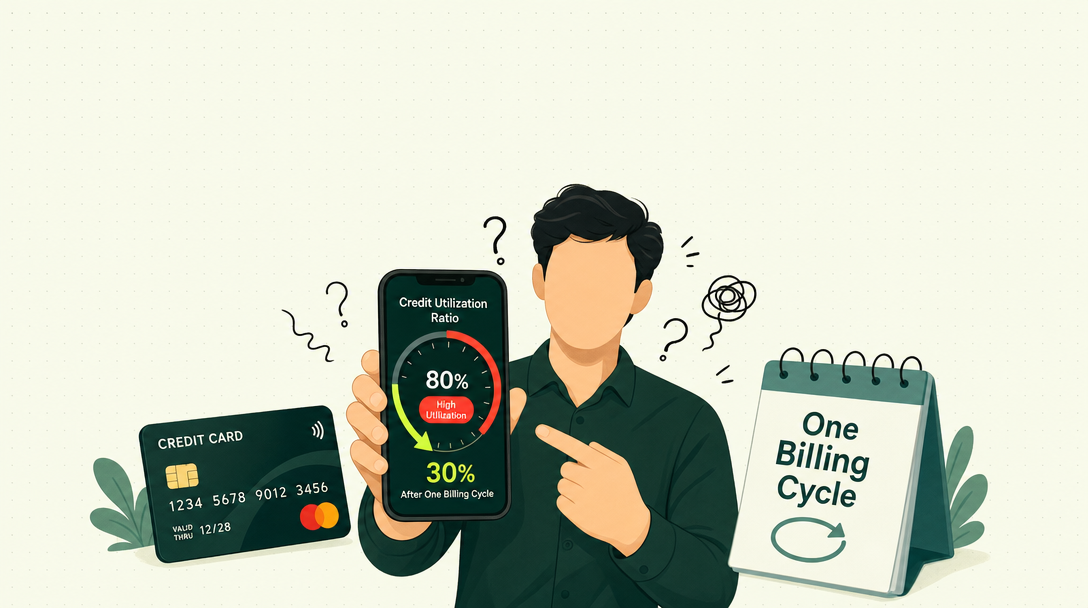
Most of what drives a CIBIL score takes years to change. Payment history builds slowly, and old defaults linger. Credit utilization is the exception. It reflects how much of your available card credit you are using right now, and it can move your score within a single reporting cycle.
That makes it the most useful lever for anyone planning to apply for a loan in the next few months. This guide explains how utilization is measured, why the popular 30% rule is only half right, and the practical steps that lower it without changing how much you spend.
What credit utilization ratio means
Credit utilization ratio is the share of your total revolving credit limit that is currently in use. In practice, that means credit cards and similar revolving lines.
The formula is simple: total outstanding balance on your cards divided by total credit limit, expressed as a percentage. A person with ₹2 lakh of combined limits and ₹50,000 of balances has a utilization of 25%.
Instalment loans such as personal, home or car loans do not count toward utilization. They are assessed separately, through repayment history and total debt.
How bureaus and lenders read it
What gets reported
Your card issuer reports the balance outstanding on its reporting date, not the amount you eventually owe after paying. Since April 2026, lenders report to bureaus several times a month rather than once.
This is the detail most people miss. If you spend ₹80,000 on a ₹1 lakh card and pay it in full on the due date, the bureau may still record 80% utilization because the balance was reported before your payment.
Why lenders care
High utilization is one of the clearest signs of credit stress. A borrower using 85% of their limits month after month is often relying on revolving credit to cover regular expenses. Lenders see that pattern before they see a missed payment.
It affects two things: the score itself, and the lender’s manual review. Even with a 760 score, an underwriter who sees four cards near their limits may cut the offered amount or raise the rate.
The 30% rule and its limits
The common advice is to keep utilization below 30%. It is a reasonable guideline, but it is not a cliff.
- Scoring models reward lower utilization in steps, so 15% generally scores better than 29%.
- Utilization in single digits is typically seen as strongest.
- Zero utilization on every card for long periods gives the model little recent activity to assess. Light, regular use paid in full is better than no use.
Treat 30% as a ceiling to stay under, and 10% as the level to aim for in the months before a loan application.
Per-card vs overall utilization
Bureaus look at both your combined utilization and how close each card is to its limit. One maxed-out card can weigh on your profile even when your overall ratio looks healthy.
| Card | Limit | Balance | Card utilization |
|---|---|---|---|
| Card A | ₹1,00,000 | ₹60,000 | 60% |
| Card B | ₹50,000 | ₹10,000 | 20% |
| Card C | ₹50,000 | ₹0 | 0% |
| Total | ₹2,00,000 | ₹70,000 | 35% |
Overall utilization is 35%, but Card A at 60% is the bigger concern. Paying ₹40,000 on Card A before its statement date brings Card A to 20% and overall utilization to 15%, without any change in total spending.
Now consider closing Card C because it is unused. Total limit falls to ₹1.5 lakh, and the same ₹70,000 balance becomes 46.7% utilization. Closing an unused card raises your ratio overnight.
Seven ways to lower utilization
- Pay before the statement date, not the due date. The statement balance is what typically gets reported. Paying down a large purchase before the statement is generated lowers the recorded balance.
- Make two payments a month. Splitting payments across the cycle keeps the reported balance lower at any given reporting date.
- Spread large spends across cards. Avoid pushing any single card above 50%.
- Ask for a limit increase on a card you manage well. A higher limit with the same spending lowers utilization. Do it well before a loan application.
- Keep old cards open. Their limits support your ratio, and their age supports your history.
- Be careful with EMI conversions. Converting a purchase to EMI blocks the unpaid principal against your card limit, so it does not free up limit immediately.
- Move persistent card debt to an instalment loan. If balances have stayed high for months, a credit card debt consolidation loan clears the cards and replaces 36% to 42% card interest with a fixed EMI.
Common misconceptions
- “Carrying a small balance builds my score.” It does not. Paying in full costs you nothing on the score and saves interest.
- “If I pay in full every month, my utilization is zero.” Not necessarily. Utilization is measured at the reporting date, before your payment.
- “Closing cards I don’t use helps.” It usually hurts, because your total limit shrinks.
- “Utilization damage is permanent.” It is not. Once lower balances are reported, the ratio updates, unlike a missed payment.
Use cases
Arjun has three cards with ₹3 lakh in combined limits and carries about ₹2.4 lakh in balances, or 80% utilization. He plans a home purchase in six months. He takes a ₹2.4 lakh personal loan to clear the cards, which takes his card utilization to near zero. His score dips slightly after the new application, then recovers and rises over the next two to three reporting cycles as the lower balances are reported and EMIs are paid on time.
Neha spends about ₹70,000 a month on a single ₹1 lakh card and pays in full. Her reported utilization swings to 70%. She splits spending across two cards and pays mid-cycle, bringing the reported figure under 20% with no change in her lifestyle.
Key takeaways
- Credit utilization is card balances divided by card limits, measured at the reporting date.
- Below 30% is acceptable; below 10% is strongest in the months before you apply for a loan.
- Both overall and per-card utilization matter, so avoid any single card near its limit.
- Paying before the statement date lowers the reported balance more than paying on the due date.
- Persistent high balances are a debt problem, and consolidating them into an instalment loan fixes both the ratio and the interest cost.
Frequently Asked Questions
Below 30% is generally acceptable, and below 10% is considered strong. Lower is better, but keep some light, regular usage.
It helps over time, but utilization is measured when your issuer reports, which is usually before the due date. Paying before the statement date has a bigger effect.
As soon as the lower balance is reported, which now happens several times a month. You can often see a change within one to two cycles.
No. Utilization applies to revolving credit such as credit cards. Instalment loans are assessed on repayment history and total debt.
Usually not. Closing it reduces your total limit and raises utilization. Keep it open and use it lightly if there is no annual fee.
Conclusion
Credit utilization is the rare part of your credit profile that responds within weeks. Manage when you pay, not just how much; keep limits in place and avoid concentrating spend on one card. If your balances have been high for months, the issue is the debt itself, and moving it to a lower-cost instalment loan solves both the score and the interest bill.
See whether consolidating your card balances could lower your EMI.