





Credit card debt is the most expensive borrowing most Indian households carry. Interest typically runs at 3% to 3.75% a month, which is 36% to 45% a year before GST. When a bill goes unpaid, that cost compounds alongside late fees, and the account moves through a predictable sequence: charges, credit reporting, collections, write-off, and settlement.
Knowing that sequence matters, because each stage is harder to reverse than the last. This guide walks through what happens at each point, what it costs in rupees, and the specific actions that stop the slide at every stage.
The rules that govern an unpaid card bill
RBI’s directions on credit card issuance and conduct set the boundaries for banks and card-issuing NBFCs:
- A three-day buffer. Late payment charges can be levied, and the account reported to credit bureaus as past due, only when payment is more than three days late after the due date.
- No negative amortisation. The minimum amount due must be set so the balance does not grow when you pay it.
- Disclosure. Interest rates, late fees and how they are calculated must be stated in the Key Fact Statement and on the card issuer’s website.
What RBI does not do is cap the interest rate. In December 2024, the Supreme Court set aside an earlier consumer commission ruling that had limited card interest to 30% a year. Card issuers price their own rates within disclosure rules, and most charge 36% to 45% annually, plus 18% GST on interest and fees.
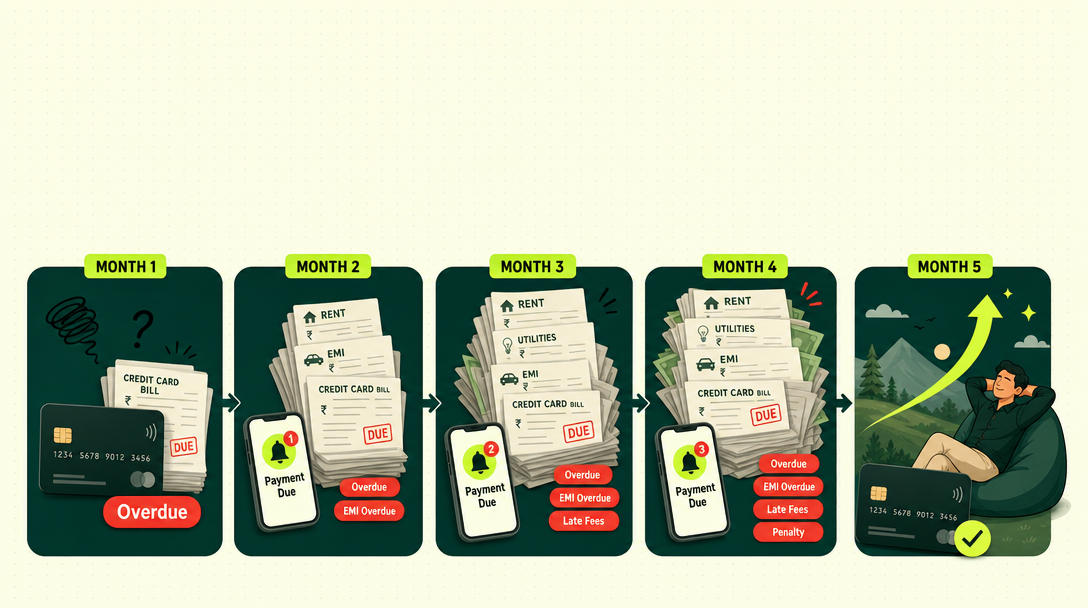
The timeline: from due date to write-off
The exact days vary by issuer, but the sequence is consistent.
Days 1 to 3 after the due date
No late fee and no adverse reporting yet. If you pay in full now, you avoid late charges, though interest still applies from the transaction dates because you missed the interest-free window.
Day 4 onward
A late payment fee is charged, usually on a slab based on the amount due. The account can be reported to bureaus as past due in the issuer’s next reporting cycle, which now happens several times a month. Interest is charged on the full outstanding balance, and new purchases lose their interest-free period until the balance is cleared.
Around 30 days past due
Your report shows a 30-day delinquency. This is the point at which most borrowers see a sharp score drop, as explained in why your CIBIL score drops. Collection calls and reminders begin. Another month’s interest and late fee are added.
Around 60 days past due
The issuer may block or suspend the card. Collection activity intensifies. The account is now classified as special mention, which flags stress to every lender who checks your report.
90 days past due
The account is typically classified as a non-performing asset. The card is usually cancelled. Collection may move to recovery agencies, which must follow RBI’s conduct rules.
Around 180 days and beyond
Many issuers write off long-overdue balances in their books. A write-off is an accounting step, not forgiveness. The debt remains recoverable, and you may receive settlement offers, legal notices, arbitration proceedings, or, in some cases, a sale of the debt to an asset reconstruction company.
What an unpaid ₹1 lakh balance actually costs
Assume a ₹1,00,000 balance, 3.75% monthly interest, 18% GST on interest and fees, and a typical ₹1,300 monthly late fee, with no payments and no new spending.
| Months unpaid | Amount owed |
|---|---|
| 1 | ₹1,05,959 |
| 3 | ₹1,18,680 |
| 6 | ₹1,39,951 |
In six months, the balance grows by about 40% without a single new purchase. That is before any collection or legal costs.
The minimum-due trap
Paying the minimum amount due, often around 5% of the balance, keeps the account current. It avoids late fees and keeps the account from being reported as past due. It does not stop interest, which is charged on the entire outstanding balance.
On the same ₹1 lakh balance, paying only the minimum each month, with no new spending, would take about 37 years to clear and cost more than ₹5 lakh in interest and GST on these assumptions. Our guide to the credit card minimum payment trap shows why the balance barely moves.
The minimum due is a short-term shield against reporting damage, not a repayment plan.
How to stop the damage at each stage
Before the due date or within three days
Pay at least the minimum amount due. If you cannot pay more, this one step avoids the late fee and keeps your report clean while you plan.
If the balance is too large to clear in two or three months
Replace card interest with cheaper borrowing:
- Convert the outstanding to EMI with your card issuer. Rates are lower than revolving interest, but compare the effective rate after processing fees.
- Use a personal loan to clear the card. A ₹1 lakh personal loan at 13% over 24 months has an EMI of ₹4,754 and total interest of about ₹14,100. That replaces a debt costing roughly 45% a year with one costing 13%.
- Consolidate several cards into one loan. Our guide to credit card debt consolidation covers how it works and what lenders look for.
After clearing the cards, keep them open but unused until the loan is paid down, so utilization stays low and you do not rebuild the balance.
If you are already 30 to 90 days late
- Call the issuer, explain the situation, and ask for a restructured plan. Issuers often prefer a structured repayment to an NPA.
- Pay the overdue minimum to bring the account current, which stops further delinquency buckets.
- Get every agreement in writing.
If the account is written off or offered for settlement
Settlement ends collection but reports the account as settled, which damages your credit for years. If you can, negotiate a plan that ends in full repayment. If you settle, get the settlement letter before paying and check your report afterwards.
Use cases
Ravi missed a ₹62,000 bill during a family emergency and noticed on day five. He paid the minimum due the same day and called the issuer to reverse the late fee as a one-time courtesy, which it did. He then cleared the balance over two cycles.
Nisha carried ₹1.8 lakh across three cards, paying minimums for a year. Her utilization was above 80%, and her score had slipped to 690. She took a consolidation loan at 14%, cleared all three cards, and set a single EMI on salary day. Within three months, her utilization fell to under 1,0% and her score began recovering.
Key takeaways
- Late fees and adverse reporting can apply only after a payment is more than three days overdue.
- From day four, the account compounds at 36% to 45% a year plus GST, and is reported to bureaus.
- At 90 days past due, the account is typically an NPA; around 180 days,s it may be written off, but the debt remains.
- Paying the minimum keeps the account current but barely reduces the balance.
- Replacing card debt with a personal loan or consolidation loan is usually the cheapest exit before the account turns delinquent.
Frequently Asked Questions
If you pay within three days of the due date, the issuer cannot charge a late fee or report you as past due. Interest still applies because you missed the interest-free period.
Non-payment of a card bill is a civil matter. Criminal proceedings can arise only in specific situations, such as a bounced cheque or fraud. Issuers recover through notices, arbitration, civil suits, ts and settlements.
It prevents late-payment reporting, but high balances still raise utilization, which lowers your score.
Only if you have authorised an auto-debit or the issuer has a contractual right of set-off in an account held with the same bank. Check your card agreement.
Only as a last resort. It ends the dispute but shows as settled on your report for years and makes new credit harder and costlier.
Conclusion
An unpaid credit card bill does not become a crisis overnight. It moves through stages, and each stage gives you a chance to act. Pay the minimum to stop reporting, replace expensive card debt with a fixed EMI, and deal with the lender before 90 days. The earlier you act, the more of your score and your money you keep.
See how much you could save by consolidating your card dues with TapTap Loans.