





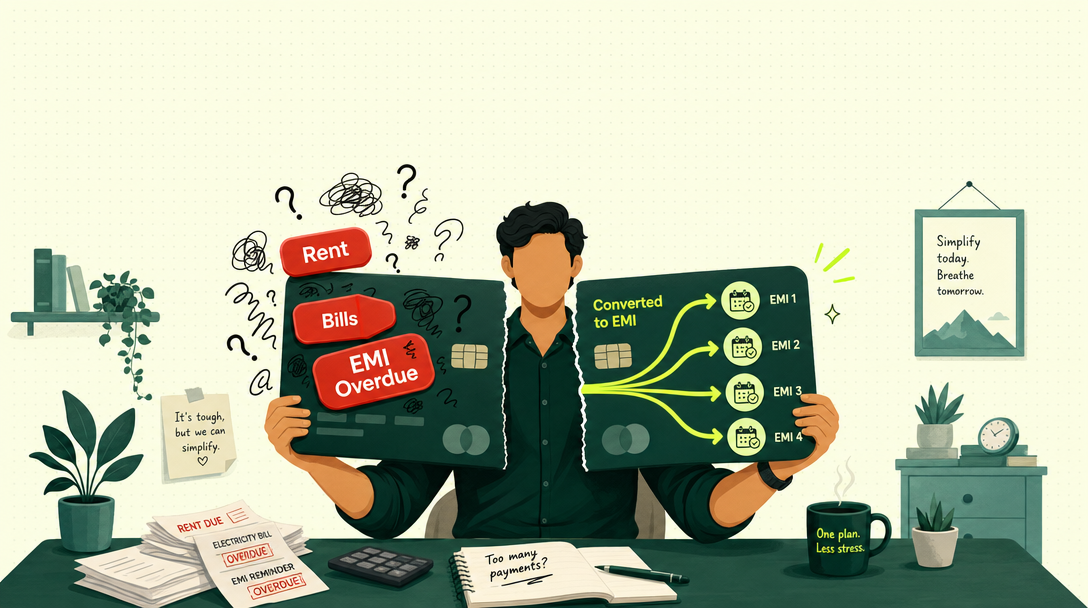
Credit card EMI lets you turn a big purchase, or your whole bill, into fixed monthly instalments. Interest is usually 13% to 24% a year, plus a processing fee and GST. That’s far cheaper than paying only the minimum due, which can cost 36% to 45% a year. But it’s not free, and it’s not always the best option.
Let’s break down how it works, what it costs, and when it makes sense.
What Is Credit Card EMI Conversion?
When you get your card bill, you have three choices:
- Pay the full amount. No interest.
- Pay only the minimum due. High interest on the rest.
- Convert some or all of it into EMIs.
Credit card EMI conversion is option 3. The bank splits the amount into monthly payments over 3 to 24 months. Each EMI then shows on your monthly bill.
There are two main types:
| Type | What it covers |
|---|---|
| Transaction EMI | A single large purchase |
| Bill EMI | The whole or part of your statement balance |
Credit Card EMI Interest Rate and Charges
Here’s what you’ll usually pay. Exact numbers vary by bank and card.
| Cost | Typical range |
|---|---|
| Interest rate | About 13% to 24% a year |
| Processing fee | ₹99 to ₹299, or around 1% to 2% of the amount |
| GST | 18% on interest and fees |
| Foreclosure charge | Some banks charge 2% to 3% to close early |
Always check the full cost on your bank’s app before you confirm. Look for the total interest and fees, not just the EMI amount.
Credit Card EMI vs Paying the Minimum Due
This is where the difference is huge. Let’s compare on a ₹60,000 bill.
| Option | Approx. annual rate | Rough interest over 12 months |
|---|---|---|
| Minimum due, balance revolves | 36% to 45% | ₹12,000 or more |
| Credit card EMI at 16% | 16% + fee + GST | About ₹6,000 to ₹6,500 |
| Personal loan at 13% | 13% + fee | About ₹4,500 to ₹5,000 |
These are estimates, but the pattern holds. EMI conversion often halves your interest compared with revolving the balance.
There’s a second benefit too. With minimum due, you also lose the interest-free period on new purchases. With EMI, your regular spends stay cleaner.
How to Convert Credit Card Bill to EMI
Here’s how to convert a credit card bill to EMI at most Indian banks. The exact screens differ slightly.
Through the Bank App or Net Banking
- Log in to your bank’s app or net banking.
- Go to the credit card section.
- Choose “Convert to EMI” or “EMI offers.”
- Select the transaction or the bill amount.
- Pick a tenure, like 6, 9, or 12 months.
- Review the interest, fee,e and total cost.
- Confirm with OTP.
Through Customer Care
Call the number on the back of your card. Ask them to convert the transaction or bill. Ask them to confirm all charges before you agree.
Timing Matters
Convert before your bill’s due date. After that, interest on the revolving balance may already apply.
Eligibility for Credit Card EMI
Most banks need:
- A minimum amount, often ₹2,500 or more
- An eligible transaction (some spends, like fuel or cash withdrawals, are excluded)
- A card in good standing, with no overdue dues
- Enough available limit
Once converted, the full EMI amount blocks your credit limit. It frees up gradually as you pay each instalment.
When Credit Card EMI Makes Sense
Credit card EMI is a good choice when:
- You made one large, planned purchase.
- You can’t pay the full bill this month, but can pay in a few months.
- You want to avoid the minimum-due trap.
- The total amount is modest, and you won’t need to borrow more.
When You Should Look at Other Options
It’s not always the best tool. Look elsewhere if:
- You have balances on several cards. Converting each separately adds many EMIs and fees. One consolidation loan may be simpler and cheaper.
- The amount is large, like ₹2 lakh or more. A personal loan often has a lower rate.
- You keep converting bills month after month. That’s a sign that spending exceeds income.
- You have an FD or gold. A loan against FD or a gold loan is usually cheaper still.
Credit Card EMI and Your CIBIL Score
EMI conversion itself doesn’t hurt your score. In fact, avoiding a missed payment protects it.
But keep in mind:
- The EMI amount blocks part of your limit, so your credit use looks higher.
- Missing an EMI is treated like a missed card payment.
Keep total card use below 30% of your limit where possible.
Our Honest Take
At TapTap Loans, we often see people with three or four cards, each with its own EMI conversion. Every month, the bills feel lighter. But the total debt barely moves.
Credit card EMI is a helpful tool. Used once, for a planned expense, it’s great. Used every month, it can hide a bigger problem. If that’s you, it may be time to look at your whole debt picture, not just this month’s bill.
Most banks charge about 13% to 24% a year on credit card EMI, plus a processing fee and 18% GST. The exact rate depends on your bank, card, and tenure.
Log in to your bank’s app or net banking, open the credit card section, and choose “Convert to EMI.” Select the amount and tenure, check the charges, a nd confirm with OTP.
Usually, yes. Revolving the balance can cost 36% to 45% a year, while credit card EMI often costs much less. It also helps you avoid the minimum-due trap.
Converting to EMI doesn’t lower your score by itself. But it blocks part of your credit limit, which can raise your credit utilization. Missing an EMI will hurt your score.
Yes, most banks allow early closure. Some charge a foreclosure fee of around 2% to 3% of the outstanding amount. Check your bank’s terms.
Conclusion
Credit card EMI turns a stressful bill into steady payments, at a much lower cost than revolving the balance. Convert before the due date, compare the total cost, and pick a short tenure you can manage.
But if you’re converting bills every month, or juggling several cards, step back. A single lower-rate loan or a secured option may be the smarter move.