





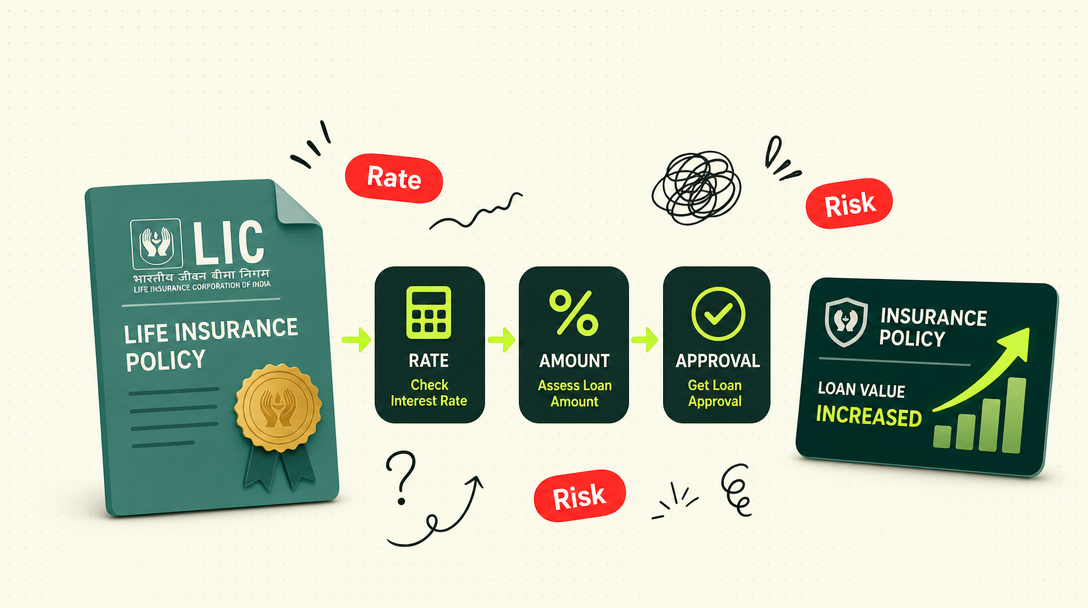
Indian households quietly hold lakhs of crores in traditional life insurance policies, endowment plans, money-back policies, and whole life. Most policyholders don’t realise these policies have a parallel use: collateral for low-cost loans. A loan against an LIC policy, postal life insurance, or a private insurer’s traditional plan typically costs 9–11%, substantially below personal loans, and uses an asset you already own.
This guide walks through which policies qualify, how much you can borrow, what each insurer charges, and the decision between borrowing against the policy versus surrendering it for cash. By the end, you will know whether your policy is loan-eligible and the exact steps to convert it into liquidity.
Which Policies Qualify
Not every insurance policy can be used as collateral. The fundamental rule: the policy must have a surrender value (i.e., accumulated cash value the insurer would pay if you cancelled it). This usually means:
| Policy Type | Loan Eligible? | Why |
|---|---|---|
| Endowment plans (LIC Jeevan Anand, Jeevan Labh) | Yes | Have surrender value after 2–3 years |
| Money-back policies | Yes | Have surrender value |
| Whole life policies | Yes | Have surrender value |
| Term insurance (pure protection) | No | No surrender value |
| ULIP (Unit Linked) | Limited | Some insurers allow after lock-in |
| Pension/Annuity plans | Sometimes | Depends on plan stage and insurer |
| Postal Life Insurance (PLI/RPLI) | Yes | After 3 years of premium payment |
If you hold a term insurance policy, you cannot borrow against it; there’s nothing to surrender. Endowment and money-back are the most common loan-eligible products in Indian households.
How Much Can You Borrow
The loan amount is based on the policy’s surrender value, not its sum assured:
| Insurer | Max Loan (% of Surrender Value) | Interest Rate (2026) |
|---|---|---|
| LIC of India | Up to 90% | 9–10.5% |
| Postal Life Insurance | Up to 90% | 10–10.5% |
| HDFC Life | Up to 80% | 10.5–12% |
| ICICI Prudential Life | Up to 80% | 11–12.5% |
| SBI Life | Up to 85% | 10–11.5% |
| Max Life | Up to 80% | 11–12.5% |
| Bajaj Allianz Life | Up to 80% | 11–13% |
Example:
- LIC endowment policy: sum assured ₹10L, premium paid for 7 years.
- Current surrender value: approximately ₹2.5L.
- Maximum loan from LIC at 90% LTV: ₹2.25L.
- Interest rate: 9.5–10.5%.
LIC Policy Loan: Rate and Process
LIC offers the most-used policy loan product in India. Key features:
- Interest rate: 9–10.5% (subject to periodic revision).
- Interest payable half-yearly (1 January and 1 July).
- Loan amount: up to 90% of surrender value (or 85% on premium-paying policies).
- Minimum tenure of policy: 3 years (full premiums paid).
- Process: online through the LIC customer portal, or offline at any LIC branch.
Documents required:
- Original policy document.
- Loan application form (LIC Form 5196).
- KYC (PAN, Aadhaar).
- Cancelled cheque for disbursal.
Processing time: 3–7 working days. Disbursal directly to your bank account.
Postal Life Insurance Loan
If you hold a postal life insurance policy (PLI) or rural postal life insurance (RPLI):
- Loan available after 3 years of policy.
- Loan amount up to 90% of surrender value (after 5 years).
- Loan amount up to 50% of surrender value (between 3 and 5 years).
- Interest rate: approximately 10%.
- Process: through the post office where the policy was issued.
Private Insurer Loans
HDFC Life, ICICI Prudential, SBI Life, Max Life, Bajaj Allianz, and others offer policy loans on traditional plans. The structure is similar to LIC but:
- LTV cap is usually 80% instead of 90%.
- Rates are slightly higher (10.5–13%).
- Process is often faster (24–48 hours digitally).
Loan vs Surrender: When Each Makes Sense
Take a loan against the policy when:
- You need money short-term (under 5 years).
- Your policy is on track to deliver good maturity benefits.
- You can comfortably pay loan interest while continuing premiums.
- You don’t want to lose the life cover.
Surrender the policy when:
- The policy is fundamentally a bad investment (low ROI, expensive premiums).
- You can replace the life cover with cheaper term insurance.
- You don’t need the maturity benefit and want full liquidity.
- Loan interest would exceed the policy’s bonus/loyalty addition.
Most financial advisors recommend keeping good policies and borrowing against them, since the policy’s bonus often exceeds the loan interest cost over time.
Step-by-Step: How to Apply for LIC Policy Loan
- 1. Log in to LIC Customer Portal (licindia.in).
- 2. Navigate to Online Services > Loan > Online Loan Request.
- 3. Select the policy you want to borrow against.
- 4. The portal displays the maximum loan available.
- 5. Choose a loan amount within the cap.
- 6. Submit athe pplication; loan disbursed to your registered bank account in 3–7 working days.
- 7. Interest is auto-deducted half-yearly.
- 8. Repay principal anytime (no prepayment penalty).
Repayment Rules and Default Consequences
A loan against a policy is more lenient than other loans:
- No fixed EMI schedule; only interest payable periodically.
- The principal can be repaid anytime in full or in parts.
- No prepayment penalty.
- If unpaid at maturity, the loan + interest is deducted from the maturity benefit.
- In case of death during the loan period, the loan + interest is deducted from the death benefit paid to the nominee.
This is the most borrower-friendly loan structure available in India. The trade-off is that interest accrues even if you don’t pay, and total dues at maturity/death can balloon.
Frequently Asked Questions
3–7 working days online; longer offline. Some private insurers process in 24–48 hours.
Yes, if it has surrender value. Paid-up policies (where you stopped paying premiums but the policy continues at reduced cover) usually qualify.
No. The policy stays active as long as you continue paying premiums. A loan is a parallel obligation.
You cannot borrow more than the LTV cap on the current surrender value. As you continue paying premiums, surrender value grows, and you can borrow more.
Interest on a policy loan is generally not deductible unless the loan is used for business purposes (then Section 36 may apply).
Conclusion
If you hold a traditional life insurance policy, it is an underused source of low-cost liquidity. Rates of 9–12% beat personal loans; the policy continues to provide cover, and the borrower-friendly repayment structure makes it ideal for medium-term cash needs.
Compare a loan against policy vs personal loan vs LAF with TapTap Loans before deciding which suits your situation.