





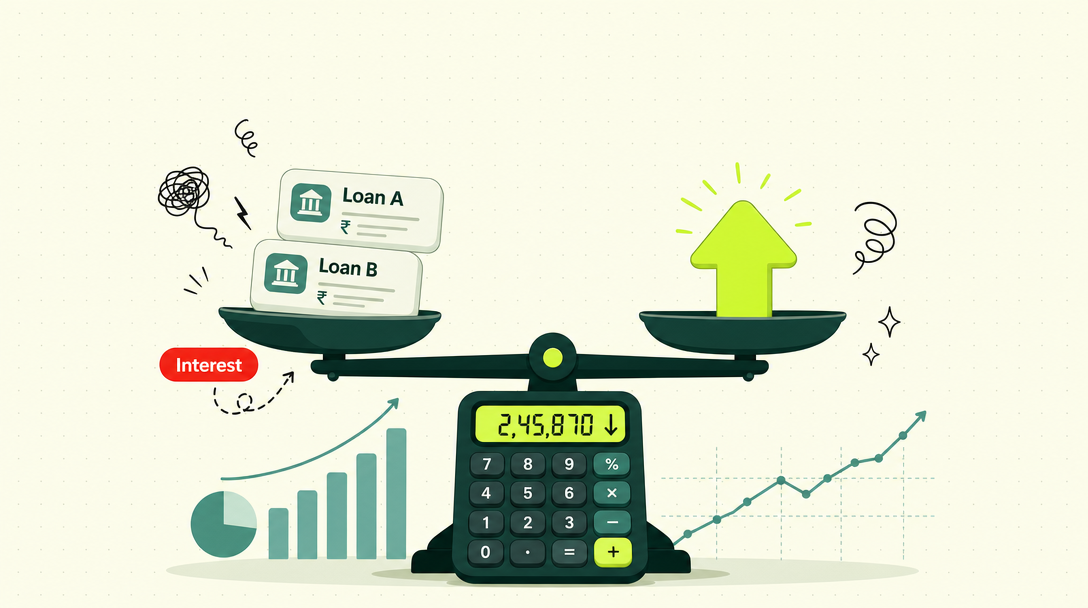
A balance transfer calculator compares two scenarios side by side: continuing your existing loan or credit card at its current rate, versus switching to a new lender’s offered rate. The output that matters most isn’t just the new EMI; it’s the total interest saved over the remaining tenure, after accounting for transfer fees and processing charges.
Many borrowers make the mistake of comparing only the monthly EMI difference. A lower EMI achieved by stretching the tenure longer can actually mean paying more total interest, even at a lower rate,e which is why the full comparison matters more than the headline number.
Inputs You Need
To calculate your real savings, gather:
- Outstanding principal — how much you currently owe
- Current interest rate — the rate you’re paying today
- Remaining tenure — months left on your current loan
- New offered rate — the rate quoted by the potential new lender
- New tenure — whether you’re keeping the same remaining tenure or restructuring it
- Fees involved — processing fee on the new loan, foreclosure charge on the old one (if applicable)
The Manual Formula (Simplified)
EMI is calculated using the reducing-balance formula:
EMI = [P × R × (1+R)^N] / [(1+R)^N − 1]
Where P is the principal, R is the monthly interest rate (annual rate ÷ 12 ÷ 100), and N is the tenure in months.
To compare two loans, calculate the EMI and total repayment (EMI × N) under your current rate/tenure, then again under the new rate/tenure, and subtract the fees from the difference. The result is your genuine net savings, ng not just a rate comparison, but a full cost comparison.
Worked Example
Consider an outstanding personal loan balance of ₹5,00,000 at 17% p.a. with 4 years (48 months) remaining.
Current scenario: At 17% p.a. over 48 months, the EMI comes to roughly ₹14,700, with total repayment over the remaining tenure around ₹7,05,600.
New scenario: A new lender offers 10.5% p.a. for the same remaining 48-month tenure. The EMI drops to roughly ₹12,850, with total repayment around ₹6,16,800 — plus a one-time processing fee of around 1% (₹5,000) on the new loan.
Net saving: Roughly ₹88,800 saved in total repayment over the remaining tenure, minus the ₹5,000 processing fee, for a net saving of approximately ₹83,800 alongside a monthly EMI reduction of nearly ₹1,850.
This is precisely the kind of comparison you should run before committing to any balance transfer: not just “is the new rate lower,” but “does the full-tenure math, after fees, actually put more money in my pocket.”
Comparing Multiple Scenarios Side by Side
The real value of a balance transfer calculator is comparing more than two options at once. Suppose you have three offers on the table for the same ₹5,00,000 outstanding balance: Lender A at 10.5% with a 1% processing fee, Lender B at 11.5% with no processing fee, and Lender C at 9.75% with a 2% processing fee. Running each through the same formula reveals that the lowest advertised rate (Lender C) isn’t automatically the cheapest overall option once its higher fee is factored in; depending on your remaining tenure, Lender A or even Lender B could come out ahead on total cost. This is precisely why comparing only the headline rate, without running the full calculation, is one of the most common mistakes borrowers make.
Why Tenure Choice Matters as Much as Rate
A subtle but important point: when you transfer a balance, you often have a choice about the new tenure: keep it the same as your remaining tenure, shorten it, or extend it. Shortening the tenure at a lower rate can sometimes produce a similar EMI to what you’re paying now, while cutting total interest substantially, since you’re paying down principal faster. Extending the tenure lowers your immediate EMI further but can increase total interest paid, even at the lower rate, if the tenure is stretched enough. A good calculator lets you test multiple tenure options against the same rate to find the balance between affordability and total cost that fits your situation.
A Second Worked Example: Credit Card Consolidation
The same calculator logic applies just as well to credit card consolidation, not just personal loan transfers. Suppose you’re carrying ₹3,00,000 across two cards at a blended 34% p.a., paying only the minimum due, which comes to roughly ₹15,000/month with the principal barely moving. Consolidating into a fixed loan at 13% p.a. over 3 years produces an EMI of approximately ₹10,100 lower than your current minimum payments while, unlike the card scenario, every rupee is amortizing the balance on a defined 36-month payoff schedule. Running this comparison through a calculator before committing shows not just the lower EMI, but the actual payoff date, which credit card minimum payments alone essentially never provide with any certainty.
Common Calculator Mistakes to Avoid
- Comparing EMI only, not total repayment — a lower EMI achieved through a longer tenure can mean paying more overall, even at a better rate.
- Ignoring fees in the comparison — a 1-2% processing fee on a large loan amount is a real cost that should be netted against your interest savings, not treated as an afterthought.
- Using your original loan’s opening balance instead of your current outstanding balance always calculate savings based on what you owe today, not what you originally borrowed.
- Forgetting to check whether your current loan has a foreclosure charge affects the “cost of leaving” your current lender, which should be part of the full comparison.
Try TapTap’s Free Savings Calculator
Rather than running these calculations by hand, TapTap’s homepage savings calculator lets you enter your total outstanding amount and current average interest rate, and see your estimated new consolidated rate, new EMI, and total interest saved instantly, with no paperwork and no credit score impact to check. It’s built specifically around the two most common scenarios Indian borrowers face: reducing EMIs on existing debt, or estimating a fresh loan’s EMI before applying.
Frequently Asked Questions
You need your outstanding principal, current interest rate, remaining tenure, the new lender’s offered rate, and any applicable fees (processing fee on the new loan, foreclosure charge on the old one).
Not necessarily. A lower rate stretched over a much longer tenure can result in paying more total interest than a higher rate over a shorter tenure. Always compare total repayment amount, not just the monthly EMI or the headline rate.
TapTap’s homepage savings calculator lets you input your outstanding amount and current rate to instantly estimate your new EMI and total savings under a consolidated or transferred rate — no sign-up or documentation required to check.
Try TapTap’s free savings calculator now and see your real numbers in under 2 minutes.