





Your card app shows a banner: “Pre-approved loan of ₹3,00,000. Money in your account in 30 seconds.” A personal loan from a bank could take a day and a few documents. The card loan looks like the obvious choice.
Sometimes it is. Often it is not. The two products are priced differently, affect your credit report differently, and suit different amounts and timelines. This guide compares them on the numbers that decide the total cost and shows when a card loan is sensible and when it quietly costs you more.
Three different things called a “credit card loan”
Borrowers use “credit card loan” for three products that behave very differently:
- Loan on credit card (within limit). A lump sum disbursed to your bank account, carved out of your existing card limit and repaid in EMIs. Your available limit drops by the loan amount.
- Loan over and above the limit. Some banks offer a pre-approved loan in addition to your card limit, repaid in EMIs through the card statement. Your spending limit stays intact.
- EMI conversion or cash withdrawal. Converting a purchase or card balance to EMI, or withdrawing cash at an ATM. Cash withdrawal is the most expensive: a fee of about 2.5% plus interest from day one at the card’s revolving rate.
This guide compares the first two with a regular personal loan. Cash withdrawal should be treated as an emergency-only option.
How a loan on a credit card works
The bank already knows your spending and repayment behaviour, so it pre-approves an amount without fresh documents. You accept in the app, choose a tenure (usually 6 to 60 months), and the money is credited within minutes.
The EMI is billed on your card statement each month. Miss it, and the unpaid EMI can attract the card’s late fee and revolving interest, which is far higher than the loan rate.
Side-by-side comparison
| Factor | Loan on credit card | Personal loan |
|---|---|---|
| Interest rate (indicative) | 11%–22% p.a., set by the card issuer based on your card history | 10.5%–24% p.a., priced on income, score, employer |
| Amount | Usually up to your card limit, or a pre-set offer | ₹50,000 to ₹25 lakh or more, based on income |
| Tenure | 6–60 months | 12–72 months |
| Processing fee | Flat ₹199–₹999 or 1%–2% | 0.5%–3% of loan |
| Documents | None | KYC plus income proof, largely digital |
| Disbursal | Minutes | Hours to 2 days |
| Credit bureau enquiry | Often no fresh hard enquiry for within-limit loans | Hard enquiry on application |
| Effect on card limit | Within-limit loans block limit | No effect |
| Choice of lender | Only your card issuer | Any bank or NBFC; comparable offers |
| Prepayment | Foreclosure fee common (around 3%) | Varies; lower or nil with many lenders |
Rates vary widely by bank and by customer. The only way to know which is cheaper for you is to compare the actual offers side by side, including the APR shown in the Key Fact Statement.
The real cost: a worked example
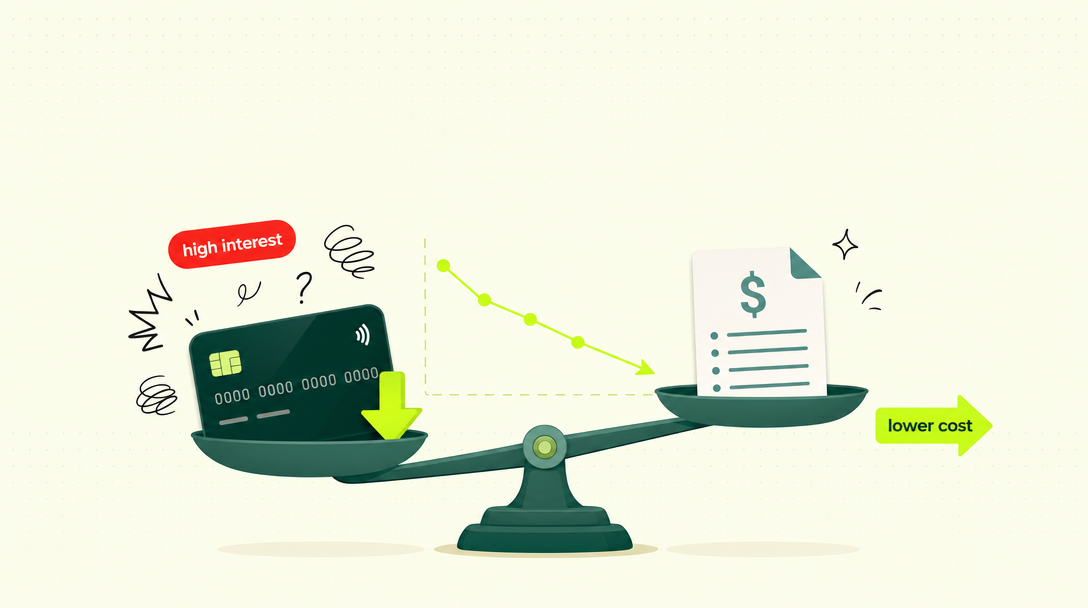
Say you need ₹3 lakh for 36 months. Your card offers 18% p.a.; a personal loan lender offers 13% p.a.
| Card loan at 18% | Personal loan at 13% | |
|---|---|---|
| EMI | ₹10,846 | ₹10,108 |
| Total interest over 36 months | ₹90,446 | ₹63,895 |
| Difference | ₹26,551 lower |
If the card offer is 15% instead, the card loan’s total interest drops to ₹74,386, still about ₹10,500 more than the personal loan at 13%.
The convenience of a 30-second disbursal is worth something. It is rarely worth ₹10,000 to ₹25,000 on a loan of this size. On small amounts for short periods, though, the gap shrinks to a few hundred rupees and convenience can reasonably win.
How each affects your CIBIL score
Card loan within limit. Blocking part of your limit raises your credit utilisation ratio, which is one of the factors in your score. A ₹3 lakh loan on a ₹4 lakh card pushes utilisation to 75% on that card until you repay. Utilisation above about 30% tends to weigh on scores.
Card loan over limit. Some issuers report it as a separate loan account. Utilisation on the card is unaffected.
Personal loan. The application creates one hard enquiry, and the loan appears as a new instalment account. Once you pay on time for a few months, a well-managed instalment loan typically supports your score rather than hurting it.
For a detailed look at enquiries, read soft inquiry vs hard inquiry.
When a card loan makes sense
- You need a small amount, under about ₹1 lakh, for 6 to 12 months.
- The card offer is competitive, within 1 to 2 percentage points of personal loan quotes.
- You need the money within hours and cannot wait for a personal loan to be processed.
- You want to avoid a fresh hard enquiry because you plan to apply for a home loan soon.
- The loan is over and above your limit, so utilisation does not rise.
When a personal loan is the better choice
- You need more than your card offer, or more than ₹1 to ₹2 lakh.
- You want a longer tenure to keep the EMI low.
- Your profile qualifies for a lower rate than your card issuer is quoting.
- You may want to prepay; card loans often carry foreclosure fees.
- You are consolidating several debts and want one EMI.
Our guide on how to compare personal loan offers without applying everywhere explains how to get multiple quotes without multiple hard enquiries.
If you already carry card debt
The comparison above assumes you are borrowing fresh money. If you are already revolving a card balance, the calculation changes sharply.
Card revolving interest in India typically runs at 3% to 3.75% a month, which is 36% to 45% a year. A borrower who owes ₹1 lakh at 3.5% a month and pays only a 5% minimum due would take close to 19 years to clear it and pay around ₹3 lakh in total. Our explainer on the credit card minimum payment trap shows the maths.
In that situation, a personal loan used to pay off the card, or a consolidation loan covering several cards, can cut the interest rate by more than half. That is a different decision from choosing between two ways of borrowing new money, and it usually has a clear answer. See credit card debt consolidation in India.
Use cases
Short-term gap. A salaried borrower needs ₹60,000 for 9 months for a family function. The card issuer offers 14% with a ₹499 fee. A personal loan might save a few hundred rupees. The card loan is reasonable.
Larger planned expense. A borrower needs ₹5 lakh for 4 years. The card’s offer is ₹2.5 lakh at 17%. A personal loan at 12.5% for the full amount is both sufficient and cheaper.
Existing card balance. A borrower carries ₹2.8 lakh across three cards. Here, the right comparison is revolving at 40% versus a consolidation loan at 14% to 16%, not card loan versus personal loan.
Key takeaways
- “Credit card loan” covers loans within limit, loans over limit, and cash withdrawals; they cost very differently.
- Card loans win on speed and paperwork; personal loans usually win on rate, amount, and tenure.
- On ₹3 lakh over 3 years, a 5-point rate gap costs about ₹26,500.
- Within-limit card loans raise utilisation, which can pull your score down.
- If you already revolve card debt, consolidation is the more important decision.
Frequently Asked Questions
Sometimes, if your card issuer offers a preferential rate. More often, a personal loan is cheaper for amounts above ₹1 lakh and tenures above a year. Compare the APR in both offers.
It can. A loan carved from your card limit raises utilisation, which may lower your score until repaid. Late EMIs on either product hurt your score.
Usually yes, but many issuers charge a foreclosure fee, often around 3% of the outstanding amount. Check the terms before accepting.
No. A card EMI converts a purchase or balance into instalments. A loan on a card disburses cash to your bank account. Both are billed on the card statement
If you are paying revolving interest and the personal loan rate is substantially lower, yes. Close the loop by not running the card balance up again.
Conclusion
A loan on your credit card is a convenience product, and convenience has a price. For small, short, urgent needs, that price can be fair. For anything larger or longer, a personal loan chosen from several competing offers usually costs less.
TapTap Loans compares personal loan and consolidation offers from 20+ banks and NBFCs against what your card issuer is quoting, with a soft check that does not affect your credit score. See what you would pay, even if card balances are already building up.