





Commercial loan documents required fall into four categories. KYC, business proof, financial documents, and property papers if the loan is secured. This guide covers the complete checklist.
KYC Documents
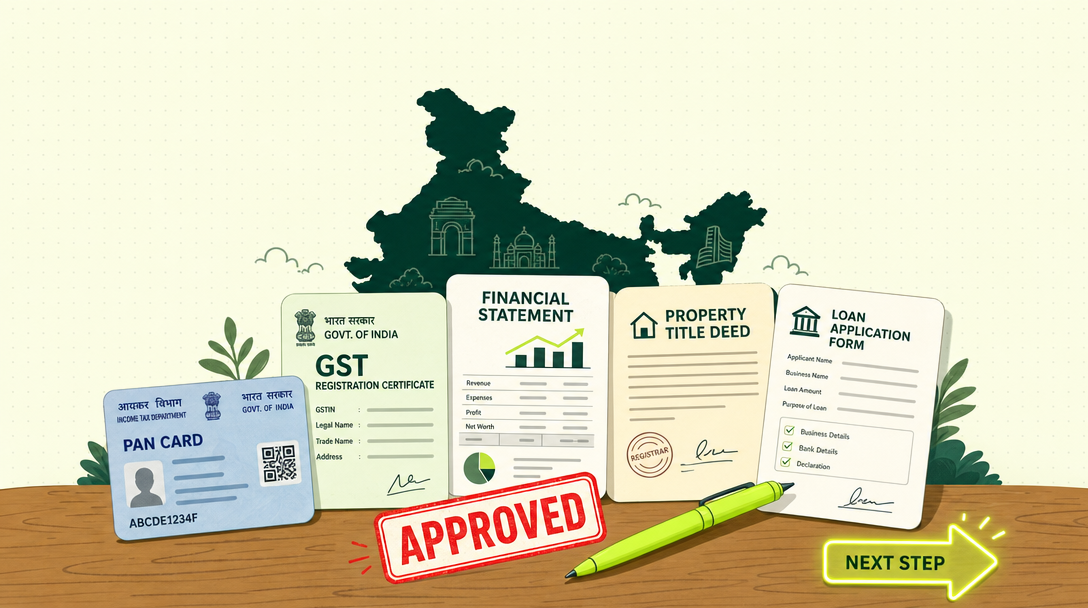
- PAN card and Aadhaar card, for all owners, partners, or directors
- Recent photographs
- Address proof, if different from Aadhaar
Business Proof and Registration Documents
- Business registration certificate, sole proprietorship, partnership deed, or company incorporation documents
- GST registration certificate
- Udyam or MSME registration, if applicable
- Trade license, where required by local regulations
Financial Documents
- ITR, 2 to 3 years, for the business and the promoter individually
- GST returns, matching the declared turnover
- Bank statements, 6 to 12 months, business account
- Audited financial statements, for larger loan amounts, typically CA-certified
Property Documents, If the Loan Is Secured
- Sale agreement or title deed
- Approved building plan
- Encumbrance certificate
- Property valuation report, usually arranged by the lender
Additional Documents for Higher Loan Amounts
Larger commercial loans often require more detailed financial disclosure. This can include a formal business plan or fund utilization statement, projected cash flows for the next 1-2 years, and details of any existing business debt or credit facilities.
Common Documentation Mistakes
Inconsistent turnover figures. Your ITR, GST returns, and bank statements should tell a consistent story. Mismatches trigger additional scrutiny and delay approval.
Missing recent filings. Submitting last year’s ITR when this year’s is already due can stall your application unnecessarily.
Incomplete property documentation for secured loans. A missing document in the property’s chain of title can hold up the entire process, sometimes for weeks.
Mixed personal and business banking. This makes it harder for the lender to isolate your actual business income cleanly.
How to Organize Your Documents Before Applying
Start with your financial documents, since these take the longest to gather if not already organized. Pull your last 2-3 years’ ITR and GST returns first. Then gather your business registration and KYC documents, which rarely change year to year. Finally, if you’re pursuing a secured loan, confirm your property documents are complete before submitting your full application.
What Happens During Document Verification
Lenders typically cross-check your submitted documents against independent sources, GST filings against the GST portal, ITR against income tax records, and property documents against local land registry records where applicable. This is why consistency across every document matters more than any single document being perfect in isolation.
A Checklist by Loan Type
| Loan Type | Core Additional Documents |
|---|---|
| Working capital loan | Recent bank statements, receivables aging report |
| Term loan | Business plan, fund utilization statement |
| Commercial property loan | Full property document set, valuation report |
| Commercial vehicle loan | Vehicle quotation, dealer invoice |
| Equipment financing | Equipment quotation, specifications |
Frequently Asked Questions
Most lenders ask for 2-3 years of ITR, for both the business and the promoter individually.
Generally yes, where the business is GST-registered, since these corroborate declared turnover. Some smaller loans may have more flexibility here.
Sale agreement or title deed, approved building plan, and an encumbrance certificate, alongside a lender-arranged valuation report.
This varies by lender and loan complexity, from a few days for smaller unsecured loans to 2-3 weeks for larger secured commercial loans.
Ready to apply? Check exactly what documents you’ll need with TapTap; we match you to the lender best suited to your business profile.