





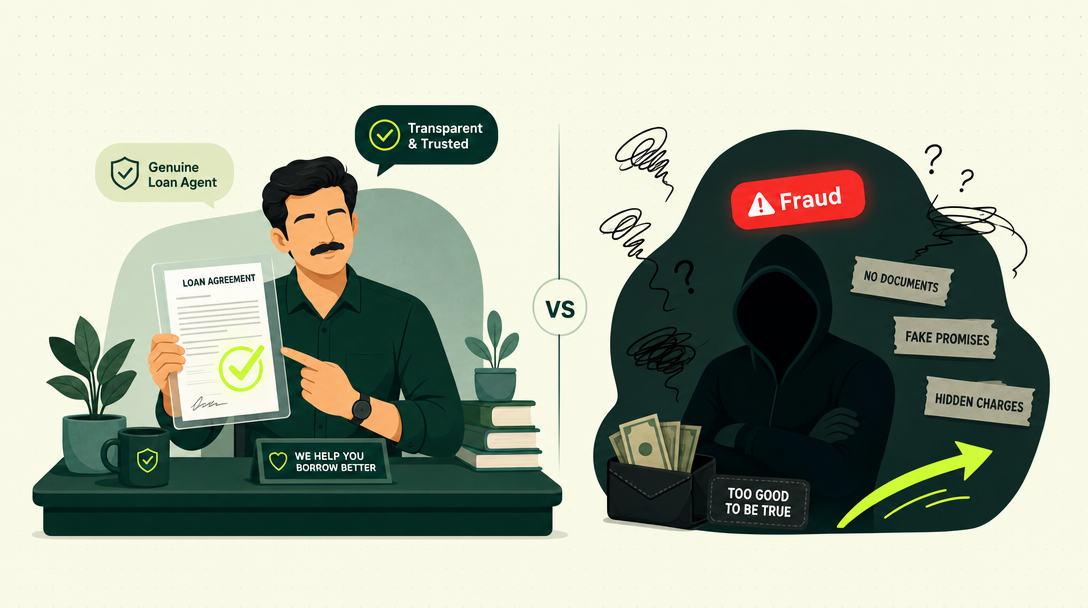
A DSA loan agent is a Direct Selling Agent appointed by a bank or NBFC to find borrowers and help them apply for loans. A genuine DSA is listed by the lender, never asks for upfront “approval fees,” never collects your EMIs in cash, and explains all charges clearly. A fake loan agent usually does the opposite. Knowing the difference can save you money and a lot of stress.
We’re a loan advisory ourselves, so this topic matters to us. Good agents build trust. Bad ones break it for everyone.
What Is a DSA Loan Agent?
The full form in banking is Direct Selling Agent.
Banks and NBFCs can’t meet every customer themselves. So they appoint DSAs, who can be individuals or companies. A DSA’s job is to:
- Understand what you need
- Suggest suitable loan options
- Help collect and submit documents
- Follow up with the lender until the loan is decided
The final decision is always the lender’s. A DSA can’t approve a loan on their own.
How a Genuine DSA Loan Agent Gets Paid
This is the most important thing to know.
In most cases, a genuine DSA is paid a commission by the lender once your loan is disbursed. You don’t pay the agent for that.
Any fee you do pay, like a processing fee, should be charged by the lender. It must appear in your Key Fact Statement and loan agreement.
If an agent asks you to pay them directly, especially before approval, stop and check.
What RBI Rules Say About Loan Agents
RBI requires banks and NBFCs that use agents to follow fair practices. In simple terms:
- Lenders should disclose the agents they work with, often on their websites.
- Agents must identify themselves and the lender they represent.
- Agents must not mislead you about rates, charges, or terms.
- Lenders remain responsible for how their agents behave.
- Recovery agents must follow strict conduct rules and can’t harass you.
So if a loan agent misbehaves, you can complain to the lender. The lender can’t just blame the agent.
Red Flags of a Fake Loan Agent
Watch for these warning signs:
| Red flag | Why it’s a problem |
|---|---|
| Asks for an upfront “file charge” or “approval fee” | Genuine DSAs are usually paid by the lender |
| Promises “100% approval” or “no CIBIL check” | Only the lender decides, and it will check |
| Asks you to pay into a personal account | Official fees go to the lender’s account |
| Won’t name the lender | A genuine agent always tells you who’s lending |
| Asks for your OTP or net banking password | Nobody legitimate needs these |
| Pressures you to decide today | Good advice is never rushed |
| Offers a rate far below the market | Too good to be true usually is |
If you notice even one of these, pause. Two or more? Walk away.
8 Questions to Ask Any DSA Loan Agent
Before you share documents, ask these questions. A genuine agent will answer them all without hesitation.
- Which bank or NBFC are you working for? Ask for their ID or authorisation letter.
- Is your name listed on the lender’s website? Check it yourself.
- Do I pay you anything? The honest answer is usually no.
- What is the exact interest rate and APR? Get it in writing.
- What is the processing fee, and who charges it? It should be the lender.
- Are there prepayment or foreclosure charges?
- Will I get the Key Fact Statement before I sign?
- How many lenders will check my credit report? Too many hard enquiries hurt your score.
Good DSA vs Bad DSA: What It Looks Like
A good DSA loan agent acts like an advisor. A bad one acts like a salesperson with a target.
| Good DSA | Bad DSA |
|---|---|
| Asks about your income, EMIs,s and goals | Only asks how much you want |
| Suggests the right loan, even a smaller one | Pushes the biggest loan possible |
| Explains all charges upfront | Hides fees until disbursal |
| Tells you when not to borrow | Never says no |
| Applies to one or two suitable lenders | Applies everywhere at once |
| Stays in touch after disbursal | Disappears once paid |
At TapTap Loans, we try hard to be the first column. Sometimes our advice is a gold loan instead of a personal loan. Sometimes it’s “wait three months and fix your credit report first.”
How to Protect Yourself When Using a Loan Agent
A few simple habits keep you safe:
- Share documents only as needed, and mark photocopies with “For loan application to [lender] only.”
- Never share OTPs, PINs, or passwords.
- Sign only after reading the Key Fact Statement and agreement.
- Pay fees only to the lender’s official account.
- Keep copies of everything you sign.
- Verify disbursal directly with the lender.
What to Do If a Loan Agent Cheated You
If you think you’ve been scammed:
- Stop further payments right away.
- Report to the lender the agent claimed to represent.
- File a cyber complaint at cybercrime.gov.in or call 1930.
- Report to RBI’s Sachet portal at sachet.rbi.org.in.
- Inform your bank if you shared account details.
Act fast. The sooner you report, the better the chance of recovery.
Frequently Asked Questions
A DSA loan agent is a Direct Selling Agent appointed by a bank or NBFC to find borrowers, help with applications, and follow up on loans. The lender makes the final approval decision.
Usually not. Genuine DSAs are typically paid a commission by the lender. Any fee you pay should be charged by the lender and shown in your Key Fact Statement.
Ask for their ID and authorisation letter, confirm the lender’s name, and check if the agent is listed on the lender’s website. Call the lender’s official customer care to confirm.
The full form in banking is Direct Selling Agent. DSAs work on behalf of banks and NBFCs to source loan customers.
Stop further payments, report to the lender, file a complaint at cybercrime.gov.in or call 1930, and report on RBI’s Sachet portal. Inform your bank if you shared account details.
Conclusion
A genuine DSA loan agent can save you time, find better offers, and guide you through paperwork. A fake one can cost you money and put your data at risk.
Ask the right questions. Check the lender’s list. Never pay upfront fees to an individual. And trust the agent who’s willing to tell you when a loan isn’t right for you.