





If you took a personal loan when your CIBIL score was lower or when interest rates in the market were higher, there’s a good chance you’re paying more than you need to. A balance transfer lets you move that loan to a lender offering a lower rate, reducing your EMI or your total interest burden without taking on new debt.
This guide covers how balance transfer loans work in India, who benefits most, the complete cost picture, and the calculations you need to do before deciding.
What Is a Balance Transfer Loan?
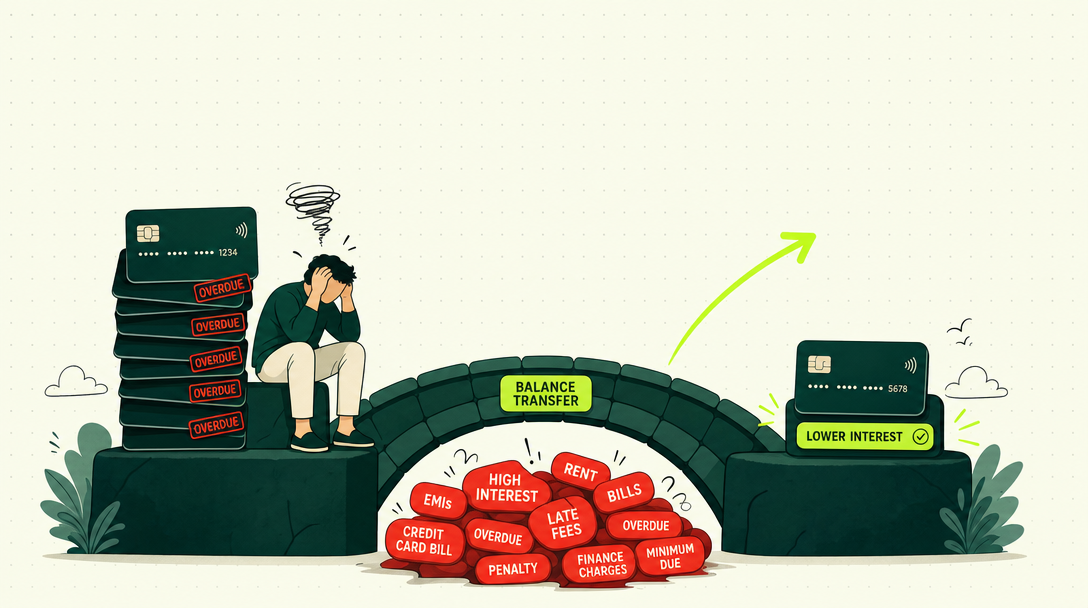
A balance transfer loan in the context of personal loans means moving your outstanding loan balance from your current lender to a new lender who offers a lower interest rate. The new lender pays off your existing loan (directly, in most cases) and creates a new loan with you at the lower rate.
Unlike loan consolidation (which combines multiple debts), a balance transfer typically moves a single loan. The purpose is not to simplify multiple payments but to reduce the cost of a single existing obligation.
How Balance Transfer Works Step-by-Step
- Identify that your current loan’s interest rate is significantly higher (by 2%+ or more) than what other lenders offer today.
- Apply for a balance transfer with a new lender. They assess your creditworthiness independently.
- Get a balance transfer sanction letter from the new lender specifying the approved amount, rate, and tenure.
- Obtain a foreclosure statement from your existing lender; this shows the exact amount needed to close the current loan, including foreclosure charges.
- The new lender typically issues a demand draft or transfers funds directly to your old lender.
- Your old loan is closed. You now repay the new lender under the new terms.
Total turnaround: 5–10 working days in most cases. Digital lenders are faster.
Who Benefits Most from a Balance Transfer?
A balance transfer delivers its maximum benefit when:
- You took your original loan 12–18+ months ago when your CIBIL score was lower (and your rate was higher). Your score has since improved, but your EMI hasn’t changed.
- The rate difference between your current loan and what you qualify for today is at least 1.5–2% per annum.
- You have at least 18–24 months of remaining tenure. A balance transfer in the final 6 months of a loan rarely saves enough to cover the fees.
- You have a clean repayment record with no missed EMI; lenders scrutinise this closely before approving a balance transfer.
What Does a Balance Transfer Actually Cost?
The mistake most borrowers make is comparing only the interest rates without accounting for the full cost of the balance transfer :
On a ₹5 lakh outstanding balance, total balance transfer costs might run ₹15,000–₹25,000, depending on lender policies. The interest savings from the rate reduction must exceed this within the remaining loan tenure for the transfer to be beneficial.
Balance Transfer Eligibility in India
Standard eligibility for a balance transfer personal loan in 2026:
- CIBIL score: 700+ (lenders want to see improved creditworthiness from when you took the original loan)
- Clean repayment: 0 missed EMIs on the existing loan (12 months of clean repayment preferred)
- Minimum outstanding: Most lenders require a ₹50,000+ remaining balance for a balance transfer.
- Minimum remaining tenure: At least 12 months
- Employment stability: Same as personal loan eligibility
Balance Transfer vs Loan Consolidation
These two tools are often confused:
- A balance transfer loan moves a single existing loan to a new lender at a lower rate; it’s not debt consolidation.
- The break-even analysis must include foreclosure charges, new processing fees, and GST, not just the rate difference.
- It works best with 18+ months of remaining tenure and a rate difference of at least 1.5–2% per annum.
- A clean repayment history on the existing loan is critical; lenders verify it before approving.
- A balance transfer addresses one loan; if you have multiple high-rate debts, loan consolidation may be more appropriate.
Frequently Asked Questions
Yes, when the math works. With at least 18 months of remaining tenure and a rate difference of 2%+ per annum, most borrowers recover the fees within 6–12 months of the balance transfer and save substantially over the remaining tenure.
Most lenders will not approve a balance transfer if you have any missed payments in the last 12 months. The new lender views your payment history as an indicator of future behaviour. Clear any arrears and maintain 6–12 months of on-time payments before applying.
Most lenders require a minimum outstanding balance of ₹50,000–₹1 lakh for a balance transfer to be viable. Below this threshold, the fixed costs of the transfer (processing fees, stamp duty) typically outweigh the interest savings.
It can be worthwhile when the new rate is significantly lower, and the interest savings exceed transfer costs.
Approval may be difficult because lenders closely review your recent repayment history.
Conclusion
A balance transfer is one of the most underutilised financial tools available to Indian borrowers. Millions of people are paying interest rates they qualified for years ago, unaware that their improved credit profile today entitles them to better terms. The calculation takes 15 minutes. If the numbers work and for many borrowers, they do a balance transfer is straightforward to execute, and the savings are real.